



Watch: Dallas vs Phoenix, Kristen shares her personal perspective after 11 years in Arizona and 12+ years in DFW. (43 min)
If you're comparing Phoenix and Dallas for a family relocation, you're asking exactly the right question, and you're not alone. In the last month alone I've heard from multiple Phoenix-area families seriously considering DFW, many from Chandler, Gilbert, and Surprise. I can give you a perspective most real estate articles can't: I'm an Arizona native. Born and raised in the Valley. My family and I lived there for 11 years before making the move to Dallas, and we've now been here over 12 years, raised our kids here, and haven't looked back. The things that surprised us in that first year were specific: our summer electric bill actually came down, our first Texas property tax bill was a jolt, and by October we were eating dinner on the patio again.
Both cities are Sun Belt metros, both are car-dependent, and both have attracted massive corporate growth. But the differences between them are significant, especially for families weighing school quality, taxes, and long-term cost of living. This guide covers the honest trade-offs so you can make the right call for your family, not just the popular one. If you've already settled on DFW and want the step-by-step, my full guide to moving from Phoenix to Dallas walks through timing, logistics, and the best suburbs for Arizona families.
Quick answer: Phoenix has much lower property taxes, but Dallas eliminates state income tax, offers a deeper job market and more top-rated school districts, and trades dry 110-degree summers for four real seasons. Home prices in the two metros land close together, so sticker price rarely decides this move. For most working families with school-age kids, the no-income-tax savings and the ISD options tip the decision toward DFW, though the math is closer for renters and lower earners.
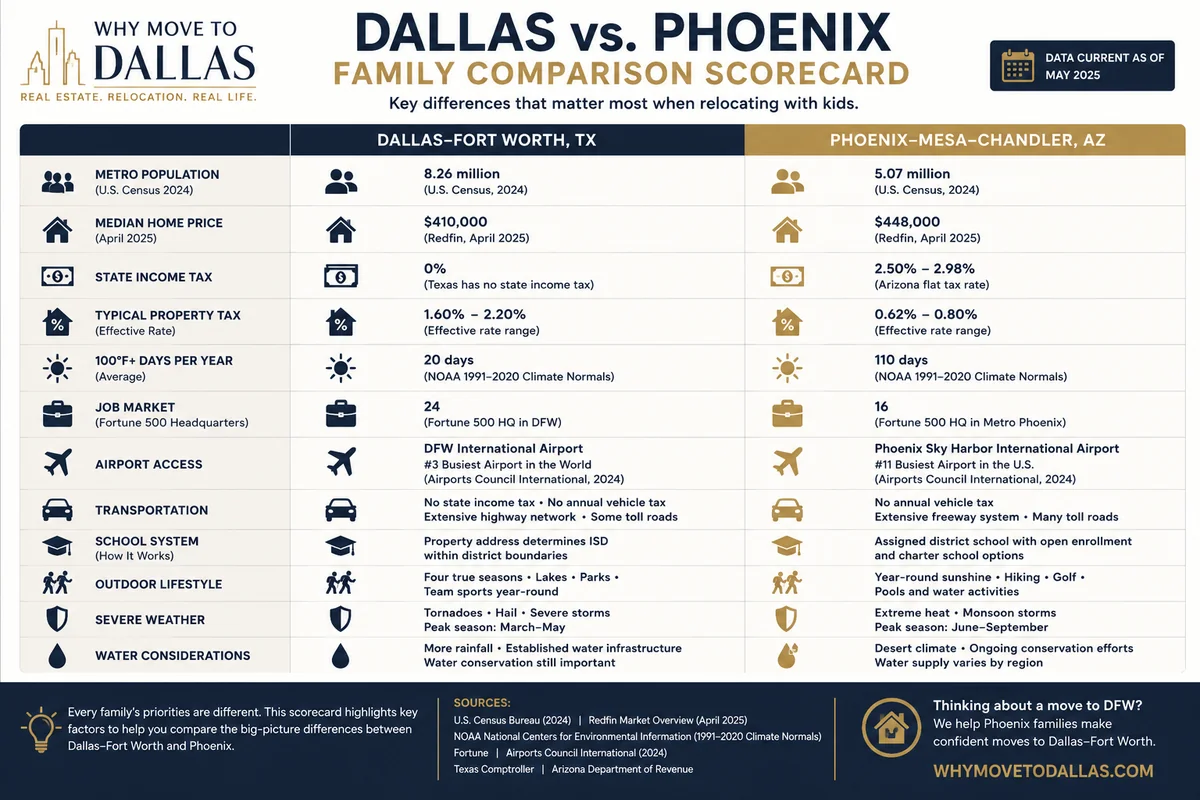
| Factor | DFW / Dallas | Phoenix Metro |
|---|---|---|
| Metro Population | 8.5 million | 5.2 million |
| Median Home Price | ~$410K to $500K | ~$448K to $465K |
| State Income Tax | 0% | 2.5% (flat rate) |
| Effective Property Tax | ~1.8% to 2.0% | ~0.63% |
| Days Above 100°F / Year | 17 to 55 days | 110+ days |
| Fortune 500 HQs in Metro | 24 | ~6 |
| City Walk Score | 46 (car-dependent) | 40 (car-dependent) |
| Major Airport Access | DFW Int'l (3rd busiest) + Love Field | PHX (mid-size) |
Sources: home prices vary by source and geography (Redfin and WhyMoveToDallas suburb data, 2025 to 2026) · U.S. Census metro estimates · NOAA · Walk Score · Fortune 500 (2026)
Demographics: Dallas vs Phoenix
Size Differences Between Dallas and Phoenix
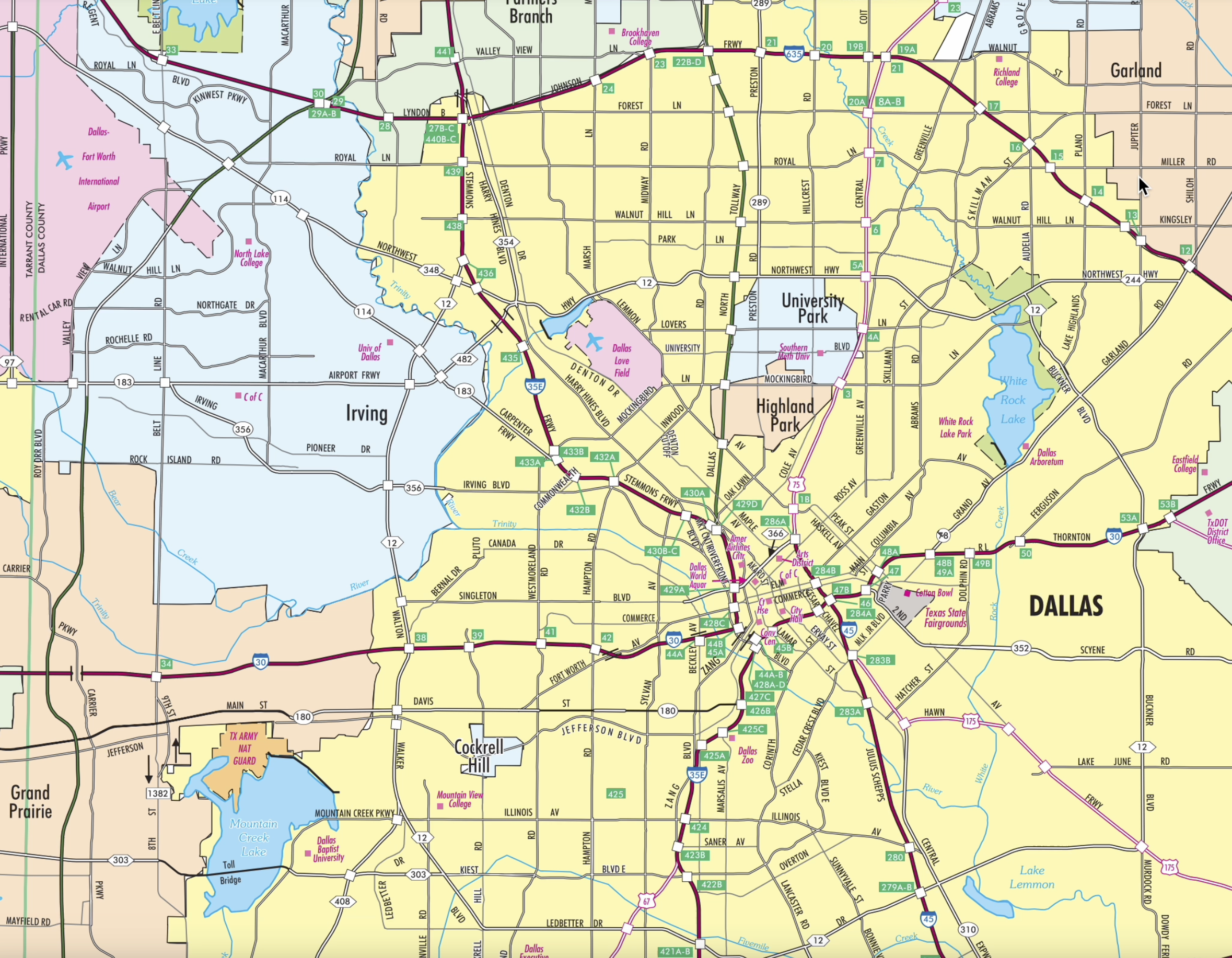
Let's start with size. The city of Dallas covers about 385 square miles, but the Dallas-Fort Worth-Arlington metro sprawls across roughly 9,300 square miles of land, the most populated metro in Texas and the southern United States. It keeps expanding, too, since there are few natural barriers to box it in the way Phoenix's mountains hem in the Valley.
Phoenix covers over 500 square miles, making it the fifth largest city in the U.S., and the entire Phoenix metro now stretches well past 14,500 square miles. I hadn't realized how big it had gotten until I started researching this. Growing up, there was barely anything out west in Buckeye or out southeast in San Tan Valley. We used to drive two-lane roads through cotton fields, so even when I go home to visit now, it looks like a completely different place.
Population Differences: Dallas vs Phoenix
The population gap between these two metros is significant. The city of Phoenix itself sits around 1.7 million residents and the city of Dallas about 1.3 million, but the metro areas tell a different story. The DFW metro reached roughly 8.5 million residents in 2025 (U.S. Census estimate), the fourth-largest metro in the country, and it added more people than any other metro that year. The Phoenix metro, including Maricopa and Pinal counties, sits at about 5.2 million, strong growth in its own right, but roughly 62% the size of DFW.
A larger metro means more options: more school districts, more employers, more neighborhoods at different price points. For families who haven't locked into an exact area yet, DFW's size is a feature, not a bug. You have 60+ suburbs to choose from, each with a distinct character and school system.
Climate and Weather: A Tale of Two Extremes
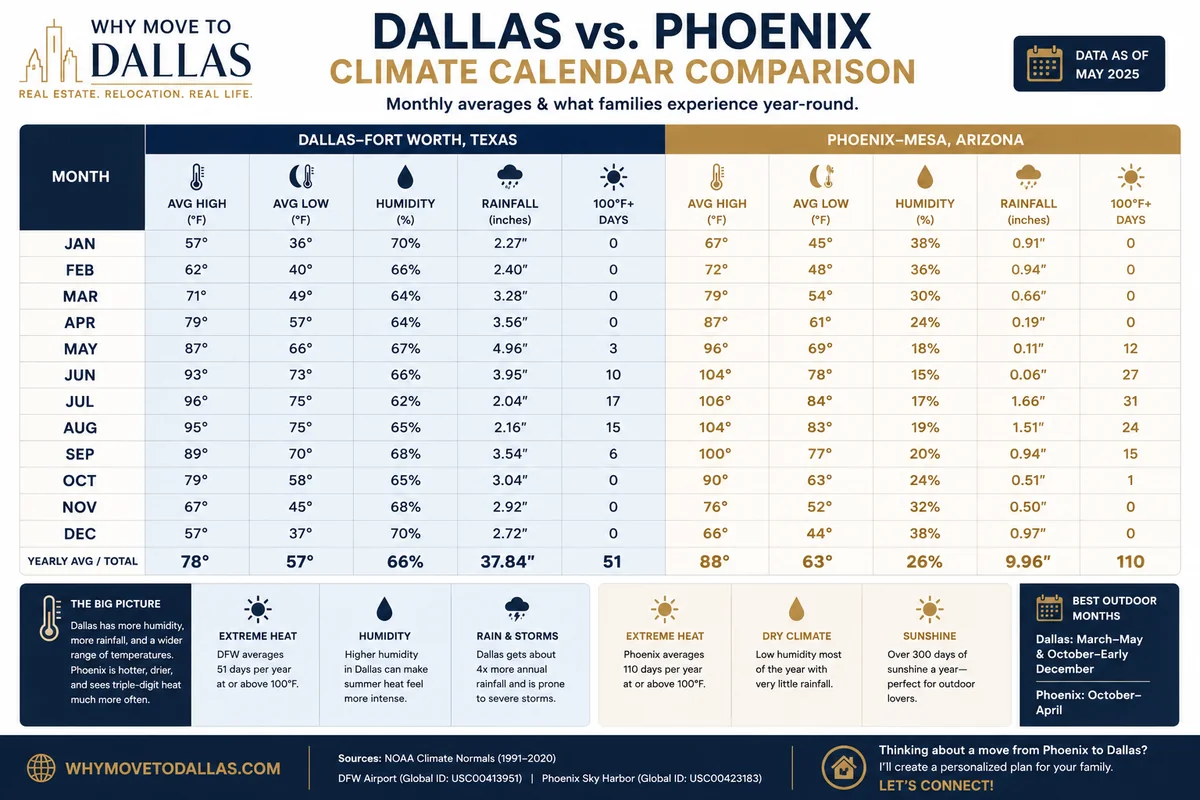
The annual averages tell only part of the story. Phoenix runs a much longer stretch of extreme heat, while North Texas pairs summer humidity with spring storm risk and the occasional winter ice.
Temperature Comparison
Phoenix averages more than 110 days per year above 100°F, and in 2024 it set a new record: 113 consecutive days at or above 100°F, far past the prior record of 76 consecutive days set in 1993. That summer was Phoenix's hottest on record. The term "dry heat" doesn't begin to describe what that feels like when you're walking to your car at 3 p.m. in July.
Dallas, by comparison, averages 17 to 55 days above 100°F per year depending on the summer. Our heat comes with humidity, so 98°F in Frisco feels different than 98°F in Scottsdale. That's a real thing. But the total number of extreme heat days is in a different category. Dallas cools down at night. Phoenix in July sometimes doesn't drop below 90°F overnight.
Seasonal Variations
Phoenix has two seasons: hot and less hot. Winters are genuinely pleasant, in the 60s and 70s, but summer lasts about six months. Dallas has four real seasons: spring thunderstorms that are occasionally severe, a true fall, and winters that can bring the odd ice storm. We're not a snow city, but ice does happen. For families moving from Phoenix, that seasonal variety is a feature. I've had clients tell me they'd forgotten what it felt like to open their windows in October. One honest note on air quality: Phoenix's ring of mountains can trap a brown haze over the Valley on still days, and DFW's flat, breezy geography disperses it, though North Texas has its own summer ozone days to keep an eye on.
Housing: Dallas vs Phoenix
A quick aesthetic note first: if your favorite color is brown, Arizona might be your place, since most homes are some shade of tan stucco set against a lot of desert dirt. Texas homes have more variety and are mostly brick. Older established neighborhoods lean traditional, while newer high-end and new-construction homes are starting to add stucco exteriors, which is less common here but growing. Either way, you'll see far more range in color and style.
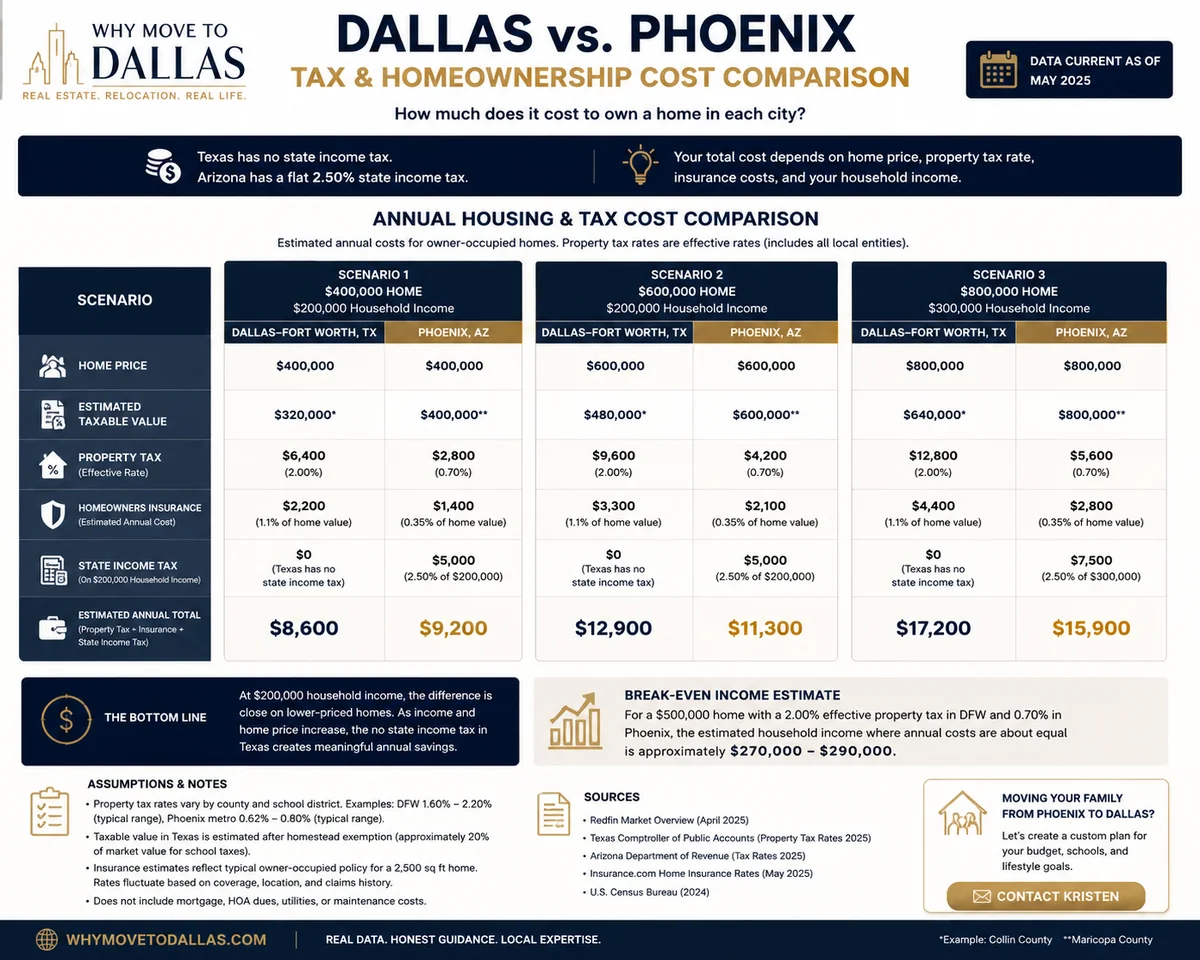
Now the numbers, and I want to be straight with you, because a lot of comparison articles overstate this. The median home prices in the two metros land close together, in the low $400s to around $500K in DFW and the mid $400s in Phoenix, depending on which source and geography you use. Sticker price rarely decides this move on its own. What does move the needle is everything around the price: Texas has zero state income tax and Arizona's flat rate is 2.5%, so on a $200,000 household income that's about $5,000 a year back in your pocket, roughly $25,000 over five years. What DFW also gives you is range. You can go from growing outer-ring cities like Celina, Forney, and Princeton, where around $400K still buys solid new construction in a strong ISD, to established suburbs like Frisco and Plano, where pricing is higher but school quality and long-term appreciation have been exceptional. New construction is everywhere: 80+ active builder communities in Celina alone. That's a completely different market dynamic from Phoenix. To start narrowing by area, browse all DFW suburb guides.
Taxes: Dallas vs Phoenix
This is the trade that drives most Phoenix-to-Dallas moves. Property taxes in Arizona run around 0.63% of a home's value, while many Texas areas average close to 2%, and newer master-planned communities can add MUD or PID district taxes on top of that. In Texas you file a homestead exemption for a discount; in Arizona the owner-occupied exemption is applied automatically. So on property tax alone, Arizona clearly wins. But Arizona charges a 2.5% flat state income tax and Texas charges none. For a working family, that no-income-tax difference is a big part of why so many people make the move. Whether it fully offsets the higher property tax bill depends on your income and your home price. On a $500K home, the extra Texas property tax runs a few thousand dollars a year, and the income-tax savings catch up to it somewhere around a $275K household income, so higher earners come out ahead while the math is closer for everyone else. Run your own numbers before you decide.
What about sales tax? Arizona's state base is about 5.6% and Texas is 6.25%, and both climb once local city and county rates are added, so the gap stays small depending on what you're buying. Minimum wage is a bigger story: Texas sits at the federal $7.25 an hour while Arizona is at $15.15 as of January 1, 2026. That matters if you have teenagers heading into their first jobs.
Cost of Living: What It Actually Costs
On the broad cost-of-living indexes, Dallas and Phoenix run close, and which one comes out cheaper depends on the index and your household. Housing sits within about 7% of each other at the metro level. The reliable, repeatable difference is the tax structure we just covered: no state income tax in Texas versus Arizona's 2.5%. For a family that's buying and earning a solid income, that's the number that moves the needle.
The costs that surprise Phoenix families most are the DFW-specific line items. Budget for toll roads if you'll commute regularly on the Dallas North Tollway, President George Bush Turnpike, or SH 121, which can run $100 to $200 a month. Homeowner's insurance is another one: North Texas gets real hail, and most policies carry a separate wind-and-hail deductible of 1% to 2% of your dwelling coverage limit, so build that into your annual budget. Utilities and healthcare tend to run a bit lower here than in Phoenix, partly because DFW isn't running air conditioning against six straight months of 110-degree afternoons.
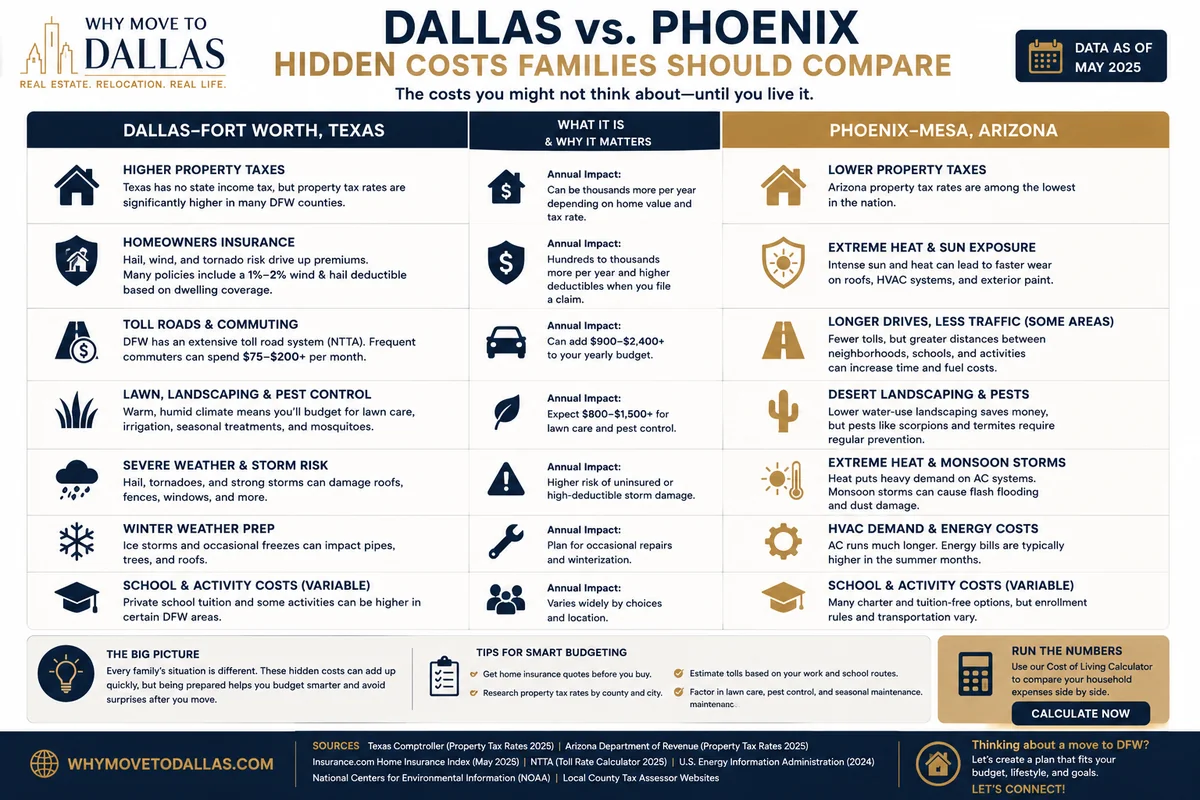
These categories can change the result more than a broad cost-of-living index. Use the calculator below to compare the numbers for your own household.
Jobs and the Economy: Dallas vs Phoenix
This is where the two metros separate most for families. DFW is home to 24 Fortune 500 headquarters (2026), including AT&T, American Airlines, McKesson, Southwest Airlines, Texas Instruments, and Charles Schwab, spread across technology, finance, healthcare, logistics, and aerospace (Bell and Lockheed both build here, and Toyota runs its North American headquarters out of Plano). That diversity is the point: if one industry softens, there's somewhere else to land. Phoenix has real private-sector strength too, from Banner Health to a fast-growing semiconductor cluster, but its very largest employers still lean more heavily on the public sector: the State of Arizona, Maricopa County, and school districts. DFW has been one of the country's leading metros for corporate headquarters relocations in recent years. If your move is employer-driven, my guide to where to live in DFW based on where you work maps the best suburbs to each major corridor.
Schools and Education
For most relocating parents, this is the whole decision, and it's also where DFW and Phoenix work differently. The draw of DFW isn't the city of Dallas schools, it's the suburban ISDs like Frisco ISD, Prosper ISD, and Highland Park ISD, which post some of the strongest TEA ratings in the state. The bigger thing to understand is how a child actually gets assigned to a school in each place, because the two systems don't work the same way.

How school assignment works in DFW
In Texas, your home address determines your Independent School District (ISD), and then the campus attendance zone within that district. Here's the catch Phoenix families miss: many DFW cities are served by more than one ISD, and district lines cross city limits, county lines, and even neighborhoods. The city name on a listing does not tell you the school. Two houses on the same street can feed different campuses.
How open enrollment and charter options work in Arizona
Phoenix works differently. Your address sets your "resident district" and the public schools assigned to you, but Arizona layers more choice on top. Open enrollment lets you apply to a school in another public district when space allows, and the state has a large tuition-free charter-school network with admission by lottery when a school is oversubscribed. That's more flexibility, but seats are not guaranteed and transportation is not always provided, so families there often chase specific schools rather than specific addresses.
Either way, the rule is the same: never assume the city name tells you the schools. Verify the exact ISD and campus attendance zone for a specific address before you make an offer. You can compare districts side by side on our DFW school districts hub, and I'm always glad to confirm the boundaries for a home you're considering.
Getting Around: Roads, Transit, and Tolls
Both metros are car-first. Phoenix runs on a clean grid of freeways (the 10, 17, 51, and the 101, 202, and 303 loops) that makes navigation simple. DFW has a sprawling freeway and tollway network tying Dallas to Fort Worth (I-35, I-20, I-30, the Dallas North Tollway, and the President George Bush Turnpike), with near-constant construction that comes with the growth. The practical difference for your budget is tolls: DFW leans on toll roads for the fastest north-south routes, so a regular tollway commute is a real monthly line item, while Phoenix's freeways are mostly toll-free. On transit, DFW has the larger system, with DART light rail, buses, and the TRE commuter line, versus Phoenix's smaller Valley Metro. In both places, most families still drive everywhere.
Lifestyle: Outdoors, Lakes, Sports, and Food
Outdoors and Lakes
This is the trade Phoenix families feel most. Phoenix is desert and mountains: Camelback, Piestewa Peak, and South Mountain put world-class hiking right in town, with Sedona and Flagstaff a short drive away. DFW is green and water: mature tree cover, shaded trails, and dozens of lakes like Grapevine, Lewisville, and White Rock, plus Klyde Warren Park downtown. And Texas lakes are warm-water lakes you can actually swim in all summer, where Arizona's run cooler and usually mean a longer drive. You trade mountain trails for lake days.
Sports, Culture, and Nightlife
Phoenix has the Suns and the Diamondbacks. DFW has the full house: the Cowboys and Rangers in Arlington, the Mavericks and Stars in Dallas, plus Friday-night high school football and a State Fair of Texas that draw crowds you have to see to believe. Nightlife in Phoenix leans on Scottsdale's resort scene, while DFW spreads across Deep Ellum's live music and Uptown's restaurants and bars.
Food, Beaches, and Travel
Phoenix does exceptional Mexican and Southwestern food. DFW gives you a wider spread: Tex-Mex, real Texas barbecue, and deep ethnic dining from Koreatown to markets stocked from all over the world. On beaches, Arizona is closer to Southern California's coast, while Texas is a few hours from the warmer, murkier Gulf. On travel, DFW International is one of the busiest airports in the world with nonstop flights almost anywhere, a genuine perk when family is spread out. Two honest trade-offs: Arizona has far more large 55+ retirement communities like Sun City, and Texas has more bugs (mosquitoes, June bugs, cicadas) where Arizona has scorpions and rattlesnakes. Pick your critters.
If you just can't stand the hot, dry desert heat any longer, reach out and let's chat. We've lived here over 12 years now, raised our kids here, and there's a lot I've learned along the way. Maybe I can help you find somewhere your family loves as much as we love it. Give me a call, shoot me a text, or send me an email, and let's talk through whether DFW is the right fit for you.
Should You Choose Dallas or Phoenix?
Every family weighs these factors differently. Here's a quick decision framework based on what I see most often when families reach out to make this move:
- Top-rated public school districts are your top priority
- You want to eliminate state income tax on your salary
- Your employer is in DFW (tech, finance, healthcare, aerospace)
- You want lush greenery, lakes, and true seasonal weather
- Four seasons, including real fall and spring, matter to you
- Dry heat is a strong preference over Texas humidity
- Lower property taxes (~0.63%) are the priority over no income tax
- Mountain hiking, Sedona, or Scottsdale weekends are part of your lifestyle
- Your job is in Arizona public sector, healthcare, or ASU ecosystem
- Proximity to Southern California beaches is important to your family
Frequently Asked Questions: Dallas vs. Phoenix

Free Download
The DFW Family Relocation Guide
Schools, suburbs, property taxes, and the buying process, everything your family needs to make the right move.
Get the Free Guide →Kristen Carpentier, TREC License #760457 · eXp Realty, 15950 Dallas Pkwy #400, Dallas, TX 75248 · Licensed in Texas only · Consumer Protection Notice · Information About Brokerage Services