

If you're researching a move to North Dallas and you keep seeing this question, I want to give you the honest answer, not a reassuring sales pitch. Frisco is still growing fast: for every 100 people who leave, roughly 188 move in. But "why are people leaving?" is a fair question, and the reasons are real. Understanding them will help you decide whether Frisco is the right fit for your family, or whether a neighboring suburb like Prosper, McKinney, or Celina might suit you better.
I've helped hundreds of families relocate to DFW from across the country. Frisco comes up in almost every conversation. Here's what I tell them, including the parts that other agents leave out.
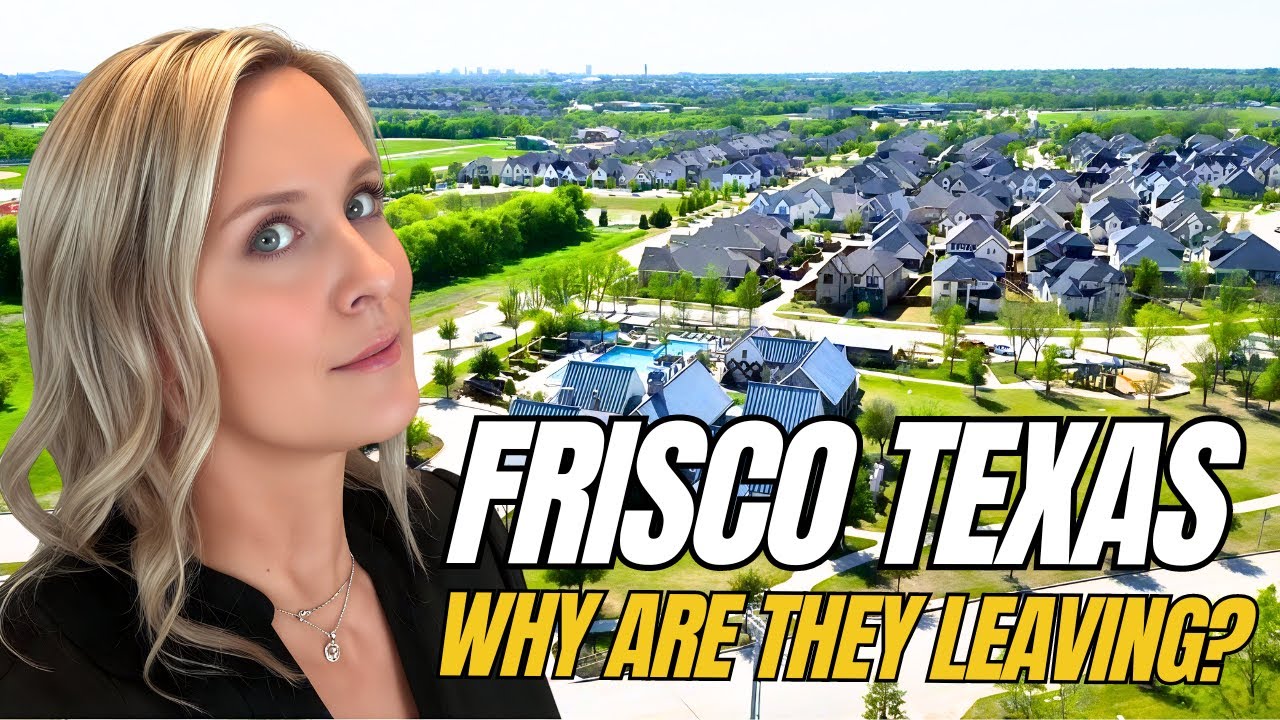
Watch: Why people are leaving Frisco, an honest breakdown of the real reasons, and what they mean for families moving to DFW.
The Cost Has Caught Up: Frisco Is No Longer "Affordable"
Ten years ago, Frisco was the value play in North Dallas. You got excellent schools and a brand-new suburb for prices well below what you'd pay in Plano or Richardson. That window has closed. The median single-family home in Frisco is now approximately $681,000, and the combined property tax rate, city, Collin County, Frisco ISD, and community college, runs around 1.78% in Collin County portions of the city.
On a $681,000 home, that's roughly $12,000 per year in property taxes before the homestead exemption. After a $100,000 homestead exemption on the school district portion, you're closer to $10,500–$11,000 annually. It's a real number, and it surprises some buyers who fixate on the purchase price without budgeting for the ongoing tax bill.
For current Frisco residents, particularly those who bought five or more years ago, this appreciation is a wealth win, and some are choosing to cash out and move somewhere with more space for less money. For buyers entering the market now, it's a real affordability ceiling. HOA fees in many of Frisco's gated and master-planned communities add another $150–$500/month on top of the tax bill. And if your home sits within a Municipal Utility District (MUD), which many master-planned communities in Frisco do, expect an additional 0.25%–0.75% added to your effective tax rate. It's a line item that catches a lot of buyers by surprise when the first tax bill arrives.
The families I work with who leave Frisco citing cost are almost always comparing it to what they could get in Prosper, Celina, or Anna, not to where they came from. When I run the numbers against San Jose or Westchester, Frisco still wins by a significant margin, especially once you factor in zero Texas state income tax. But if you've already been living in DFW for five years and you're watching Celina build brand-new construction at $440K, the math looks different.
Traffic Is the Daily Complaint You'll Hear from Every Resident
Ask anyone who's lived in Frisco for more than two years what they'd change, and traffic comes up within 30 seconds. The Dallas North Tollway, the main artery connecting Frisco to Plano, Legacy West, and downtown Dallas, is a parking lot during morning and evening rush hours. US-380 through central Frisco sees the same pattern. The city has added lanes, built new roads, and issued bond packages, but the infrastructure has consistently lagged behind the population growth.
Being car-dependent is the baseline in Frisco. The transit score is effectively zero, there's no rail service and minimal bus coverage. Every errand, school pickup, sports practice, and grocery run requires a car. For families coming from New York or Chicago who are used to hopping on a train, this is a genuine lifestyle adjustment. For families relocating from suburban California, it's roughly what they're used to, just on different roads.
The toll costs add up meaningfully. A household commuting to Dallas via the DNT can spend $200–$350 per month in tolls alone if they're making the trip five days a week. That's a real line item that should be in your budget when you're comparing Frisco's carrying costs to other suburbs.
Frisco ISD Is Still Excellent: But It's Managing Its Growth
This one requires nuance. Frisco ISD earns an A+ from Niche across every academic category, overall, academics, college prep, and good for families. The district consistently ranks in the top tier of Texas ISDs. Those ratings haven't slipped. But the district grew from a few thousand students to a peak of about 67,000, enrollment is now stabilizing around 65,000 as the city's growth rate moderates, and some elementary schools do run near capacity during growth spurts.
Frisco ISD's response has been to build new campuses, and they've done it consistently. When a neighborhood fills up, a new school typically follows within a few years. The feeder patterns shift as new schools open, which occasionally creates confusion for families who bought specifically to feed into a particular campus. This is worth asking about directly when you're buying in a specific neighborhood.
| Category | Frisco ISD Rating |
|---|---|
| Overall Niche Grade | A+ |
| Academics | A+ |
| College Prep | A+ |
| Good for Families | A+ |
| TEA Accountability | Exemplary |
The honest summary: Frisco ISD is still one of the best school districts in Texas. The growth concerns are real but managed. If top school ratings are your primary driver, Frisco still delivers. If you specifically want your kids in a smaller, quieter district where they're less likely to be in a newly rezoned school, you might prefer Flower Mound (Lewisville ISD), Southlake (Carroll ISD), or Prosper (Prosper ISD).
Most People "Leaving" Frisco Are Moving North: Not Out of DFW
This is the detail that gets lost in every headline about Frisco departures. The majority of residents who leave Frisco are not fleeing Texas or even the DFW suburbs. They're moving 10 to 20 miles north to Prosper, Celina, McKinney, or Anna, chasing more square footage, newer construction, bigger lots, and lower entry prices.
This pattern is as old as suburban growth itself. Frisco was once the destination for people leaving Plano for more space and lower prices. Now Frisco is Plano, and the new frontier is further north. Celina in particular has attracted significant attention from Frisco residents looking for half-acre lots and new construction under $500,000.
For families relocating from out of state, this context matters a great deal. The question isn't really "is Frisco losing population?", it's "is Frisco the right starting point for my family, or should I be looking at where those Frisco residents are heading?" Both answers can be correct depending on your priorities, your timeline, and your budget.
Growth Pains: What They Actually Look Like Day-to-Day
Frisco has grown by roughly 88% since the 2010 census. That kind of growth is impressive on a city hall slide deck and genuinely difficult on a Tuesday afternoon. Here's what the growth pains look like practically, from conversations with residents and clients:
Construction is permanent and everywhere. Roads that were smooth two years ago are being widened; new communities are going up on what used to be open land on the city's fringes; major developments like The Fields (a 2,400-acre mixed-use project on the north side) are actively under construction and will add thousands of homes and significant commercial density over the next decade.
The restaurant and retail scene is genuinely good, Frisco scores well above average for dining and shopping compared to other DFW suburbs. But the growth in population has consistently outpaced the growth in amenities, so there's a recurring feeling among long-term residents that their favorite spots are now crowded and parking is a battle on weekends.
Mayor Jeff Cheney himself identified the lack of arts and cultural entertainment as a primary reason residents leave, which is a notable thing for a city's own mayor to say publicly, and a fair one. Frisco has sports (The Star, Toyota Stadium, the PGA headquarters), excellent retail, and a vibrant restaurant scene. It does not have a thriving arts district, live music culture, or the kind of creative neighborhood feel you'd find in a more urban setting. Families for whom that matters tend to point toward Dallas proper, Fort Worth's Sundance Square, or more urban neighborhoods.
That said, the entertainment picture in Frisco is changing. Universal Kids Resort, a 20-acre theme park with seven themed lands designed specifically for families with young children, is set to open in Frisco on July 1, 2026. It's the first Universal-branded park in Texas, and it's located directly in Frisco, not in a nearby city. For families with kids under 12, this is a genuine addition to the city's family amenity stack. It won't satisfy the crowd that wants live music and gallery walks, but it meaningfully closes the gap for anyone whose "entertainment" is really code for "things to do with my kids on a Saturday."
Frisco trades cultural diversity and urban energy for extraordinary schools, new infrastructure, and a family-forward environment that's hard to match in DFW. If you're a family with kids in school, two working parents, and a packed activities calendar, Frisco is built for you. If you want walkable neighborhoods, live music, independent coffee shops, and an eclectic arts scene, you'll find yourself driving to Dallas a lot and wondering why you didn't just live closer to it.
What This Means If You're Moving from California, New York, or Illinois
Here's the honest reframe: most of what drives local Frisco residents away is a comparison to what's available elsewhere in DFW. For families arriving from high-cost-of-living states, the calculus looks very different.
A family earning $146,000, the median household income in Frisco, pays no Texas state income tax. In California, that same income generates roughly $10,000–$12,000 in state income tax annually. The property tax difference on a $681,000 home (Texas ~$10,500/year vs. California ~$7,500/year on a new purchase) is real, but it's more than offset by the income tax savings for most households above $100,000.
| Factor | Bay Area / CA | NYC / NY | Frisco, TX |
|---|---|---|---|
| Median Home Price | $1.3M+ | $800K–$1.1M | $681K |
| State Income Tax (on $146K) | ~$11,000/yr | ~$9,500/yr | $0 |
| Property Tax Rate | ~1.1% | ~1.5–2.1% | ~1.78% |
| School District Rating | Varies widely | Varies widely | A+ (Niche) |
| Commute to Major Employers | 45–90 min avg | 30–75 min avg | 25–40 min avg |
The traffic concern is genuine, but it's a DFW-wide reality, not a Frisco-specific one. Anyone commuting in the Dallas metro is dealing with traffic. Frisco's commute to the major employment corridors along the DNT (Legacy West, The Star, Toyota headquarters) is actually quite short for many residents. The people who feel the traffic worst are those commuting all the way to downtown Dallas, a 45- to 55-minute drive during rush hour that can be avoided by choosing a job corridor that matches your neighborhood.
- Top school ratings are your single highest priority for your kids
- Your employer is at Legacy West, The Star, or along the DNT corridor
- You're relocating from a high-cost market and want established infrastructure
- You want easy access to major retail, dining, and sports venues
- Your budget is $550K–$900K and you're comfortable with Collin County taxes
- You value a walkable neighborhood feel, Frisco scores 80 (Very Walkable)
- You want more land, a bigger lot, or newer construction under $500K
- A quieter, less dense environment is important to your family's lifestyle
- You're fine with a longer drive to employer corridors in exchange for space
- A slightly smaller school district with less rezoning activity appeals to you
- You'd rather buy into an up-and-coming market than a more mature one
The families who leave Frisco, and the ones who thrive there, are often making the same comparison. It comes down to where you are in life, what your kids need right now, and what you're optimizing for. Frisco is one of the best-built suburbs in DFW. It's also more expensive and more congested than it was five years ago. Both things are true.
If you're trying to figure out whether Frisco or a neighboring suburb is the right fit for your specific situation, school ages, commute corridor, budget, community size, that's exactly the kind of conversation I have with families every week. My Suburb Matcher is the fastest way to start: it weighs those exact levers and emails you a personalized shortlist. It's always easier to get it right before you move than after.
Frequently Asked Questions
Is Frisco, Texas still growing in 2026?
Yes, Frisco continues to grow and was forecasted as one of the top cities for movers in 2026. The city gains roughly 188 residents for every 100 who leave. Growth has moderated from its peak pace, but Frisco remains one of the fastest-growing suburbs in North Texas, with major developments like The Fields adding thousands of new homes over the next decade.
What are the biggest downsides of living in Frisco, Texas?
The most common complaints are home prices (median ~$681K), property tax bills (~$10,000–$12,000/year), traffic congestion on the Dallas North Tollway and US-380, high toll road costs, and the feeling that Frisco has lost its small-town character as it developed. The arts and cultural scene is also limited compared to what you'd find in a more urban setting.
Are Frisco ISD schools overcrowded?
Frisco ISD has grown significantly and manages capacity by building new campuses as neighborhoods fill in. Some elementary schools run near capacity, and feeder patterns do shift when new schools open. Despite this growth pressure, Frisco ISD maintains an A+ rating from Niche and remains one of the top-ranked districts in Texas, the quality has not slipped.
Is Frisco, Texas safe?
We do not rank or compare suburbs by safety. Every family weighs safety differently, so review NeighborhoodScout, City-Data, and the local police department's public crime data for any specific Frisco address you are considering, and visit the neighborhood at different times of day.
Is Frisco too expensive for families moving from out of state?
It depends where you're coming from. For families relocating from the Bay Area, New York Metro, or Chicago suburbs, Frisco's $681K median represents meaningful savings. The absence of Texas state income tax also offsets much of the higher property tax rate, a family earning $146K saves roughly $10,000–$12,000 per year in income tax compared to California, which more than covers the property tax difference.
Should I move to Frisco or consider Prosper, McKinney, or Celina instead?
Frisco suits families who want established walkable access to dining, shopping, and entertainment, top-tier schools, and a mature community with strong resale value. Prosper, McKinney, and Celina offer more land, newer construction, and lower entry prices, at the cost of a longer commute and less established amenity infrastructure. The right answer depends on your school priorities, budget, and how much you value space vs. convenience.
If you're working through this decision right now, I'd love to help you map it out. Most families benefit from a 30-minute conversation before they start touring homes, it's much easier to rule suburbs in or out when you understand what each one actually offers for your specific situation. You can read the full Frisco, Texas family guide here, or reach out directly at [email protected] or (602) 405-4115.

Free Download
The DFW Family Relocation Guide
Schools, suburbs, property taxes, and the buying process, everything your family needs to make the right move to North Texas.
Get the Free Guide →Kristen Carpentier, TREC License #760457 · eXp Realty, 15950 Dallas Pkwy #400, Dallas, TX 75248 · Licensed in Texas only · Consumer Protection Notice · Information About Brokerage Services