


Quick answer: A New York to Dallas move can reduce state and local income tax exposure and open more housing choices, but the tradeoff is a more car dependent lifestyle, higher summer utility use, and property taxes that vary sharply by address. Start with the job location, an all in monthly housing budget, and verified school attendance zones. Then compare DFW communities against those constraints.
Moving from New York to Dallas is not simply a swap of one city for another. The Dallas-Fort Worth planning area covers approximately 9,448 square miles, with dozens of cities, multiple business centers, and hundreds of school attendance zones, according to the North Central Texas Council of Governments. The right choice depends less on finding a Texas version of your current neighborhood and more on deciding which daily routines you want to preserve.
This guide covers the financial reset, geography, housing, schools, transportation, and a practical sequence for choosing a home. For a broader overview, start with the DFW Family Relocation Guide and use the Suburb Matcher when you are ready to narrow the map.

Watch: Kristen's Dallas relocation guide explains how schools, commute, budget, and lifestyle turn a large metro into a practical shortlist.
What Changes Most When Moving from New York to Dallas
Taxes and the real monthly budget
New York families often begin with the income tax difference. The Texas Constitution prohibits an individual net income tax. New York State uses graduated individual income tax rates, and New York City residents also pay a separate city personal income tax. Residents of Long Island outside New York City, Westchester, and Upstate New York do not pay the NYC resident tax. The exact household impact depends on income, filing status, deductions, residency dates, and compensation structure, so use a tax professional for a personal projection.
Sources: Texas Constitution Article VIII, Sections 24-a and 24-b, current through the November 2025 amendments, and the New York Department of Taxation and Finance 2025 resident return instructions, filed in 2026. New York's highest state rate applies only at very high income, and the city schedule applies only during NYC residency. Verify the tax year and part-year residency rules that apply to your move.
Do not treat the difference as a house budget automatically. Build a replacement budget that includes principal and interest, property taxes, homeowners insurance, possible HOA dues, summer electricity, vehicle costs, tolls, and maintenance. A larger home also brings more roof, yard, plumbing, and HVAC responsibility. Use the Dallas Cost Calculator to test those categories before setting a target price.
Start with the New York routine you actually have
| Current routine | What usually changes in DFW | What to test before choosing a home |
|---|---|---|
| New York City apartment or condo | More space and parking, but fewer daily trips on foot or by transit | Vehicle needs, walkable blocks, airport access, and summer utility costs |
| New Jersey, Long Island, or Westchester suburb | A familiar suburban rhythm across a much larger, multi-center region | Actual job corridor, school address, property tax bill, and toll exposure |
| Upstate city or suburb | Housing savings are less automatic, while heat, insurance, and driving may rise | Total monthly cost, work access, home condition, and preferred community scale |
Housing, Space, and Texas Property Taxes
DFW commonly offers more square footage, garages, and private outdoor space than New York City and many close in New York suburbs. The monthly comparison is still address specific. Texas property taxes are local, not a single statewide percentage, and two similarly priced homes can carry different tax bills.
Eligible owners may apply for a residence homestead exemption. Texas school districts provide a $140,000 general residence homestead exemption for an eligible primary residence. Other local exemptions and the final tax bill vary by address and eligibility. Read the Texas Comptroller residence homestead guidance and confirm the actual tax record with the county appraisal district before making an offer.
Request four numbers for every serious home: the current assessed value, the current tax bill, the applicable exemptions, and an estimate based on your expected purchase price. Never assume the seller's current bill will become yours. Insurance deserves the same care because roof age, claims history, coverage, and deductibles influence the premium.
Texas due diligence that can surprise an out-of-state buyer
Before the option period ends, review more than cosmetic condition. Ask the inspector to explain roof condition, drainage patterns, visible foundation movement, HVAC performance, and any evidence of prior repairs. Obtain an insurance quote early enough to evaluate wind and hail deductibles, roof eligibility, and claims history before the contract deadlines become tight.
For newer communities, verify whether the property carries an HOA, municipal utility district assessment, public improvement district assessment, or other special obligation. Read the title commitment, seller's disclosure, survey, HOA documents, and tax records together. Kristen can help organize the property questions, but the county appraisal district, taxing entities, insurer, inspector, lender, title company, and applicable legal or tax professionals should confirm the final answers.
How to Read the Dallas-Fort Worth Map
There is no single downtown commute that defines the region. Major job centers include Downtown Dallas, Uptown, Las Colinas, Plano's Legacy area, Frisco, Richardson, and the airport corridor. A community that works beautifully for an office in Plano may be frustrating for a daily trip to Downtown Dallas.
- Start with the workplace: map the actual office, expected arrival time, and number of in office days.
- Add the second anchor: a spouse's job, family support, airport access, or recurring medical care.
- Test normal traffic: review Tuesday through Thursday drive times at the hours you expect to travel.
- Decide what replaces transit: many households need two vehicles, though selected neighborhoods near DART rail or mixed use districts provide alternatives for some trips.
If walkability is central to your current routine, do not rely on a citywide label. Tour the specific block. Downtown Plano, CityLine in Richardson, Addison Circle, and Las Colinas each offer different forms of compact living, while many family oriented subdivisions are designed primarily around driving.
Schools and Attendance Zones
In DFW, the city name, mailing address, school district, and assigned campus do not always match. Plano includes addresses served by Plano ISD and Frisco ISD. Parts of Dallas are served by districts outside Dallas ISD. Boundaries and programs can change, and a district grade does not guarantee a specific experience at every campus.
- Identify the exact property address.
- Use the school district's official boundary tool to verify the assigned campuses.
- Confirm the result with the district before signing a contract or lease.
- Ask about enrollment timing, transportation, special programs, and any services your child needs.
Public data is one input, not a promise of fit. Visit when possible, review official accountability data, use the DFW school district guide to organize your research, and discuss your child's priorities. Fair housing rules also mean your agent should provide objective resources and help you evaluate homes against criteria you define, not steer you toward or away from communities based on protected characteristics.
A Practical Starting Shortlist
These are comparison points, not direct equivalents to New York communities or universal recommendations. Prices below are rolling single family medians from the site's local market dataset and update independently of this article. Use them as budget signals, then test the actual work route and assigned campus for each address.
| Community | Current median | School check | Worksite and housing filter | Homes |
|---|---|---|---|---|
| Plano | $528K | Niche A; verify district and campus | Start here for established housing and jobs around Legacy, Plano, or Richardson. Test any Downtown Dallas route at your real arrival time. | View homes |
| Richardson | $470K | Niche A-; verify district and campus | Compare for Richardson, CityLine, or a more central Dallas worksite, especially if selected DART access or older housing matters. | View homes |
| Frisco | $673K | Niche A+; verify split zones | Compare for newer housing and a northern worksite. Do not make it the default for a daily Downtown Dallas commute without testing the route. | View homes |
| McKinney | $502K | Niche A; verify split zones | Compare for a northern or remote work setup, a historic core, and newer master planned choices. A central worksite changes the tradeoff. | View homes |
Market medians use the site's rolling local dataset. The displayed letters are Niche district grades, checked October 4, 2026, for Plano ISD, Richardson ISD, Frisco ISD, and McKinney ISD. TEA released its 2026 district and campus ratings on August 14, 2026; review the specific district and assigned campus on TXSchools.gov. Verify the assigned campus for every address.
Also compare the best Dallas suburbs for families and the site's guide to Dallas cost of living. The goal is a small, testable list of three to five areas, not a tour of the entire metroplex.
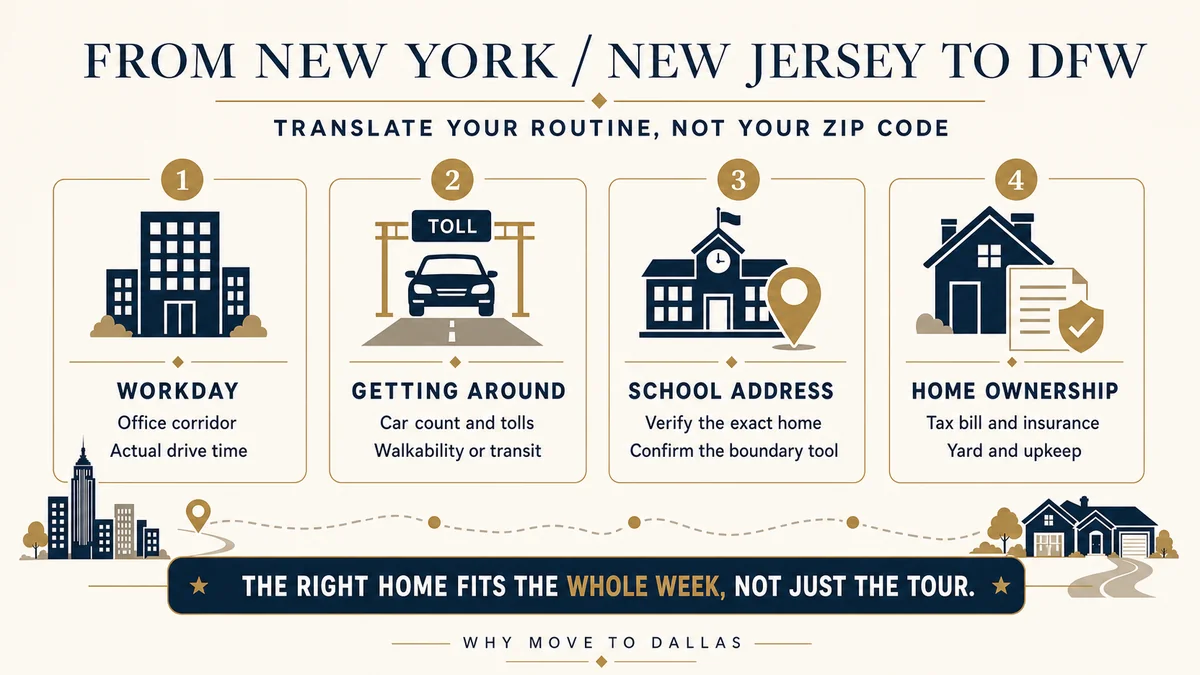
Translate the New York routine, not the New York label
Write down a normal weekday before looking at listings. Note when each adult leaves home, where children need to be, how groceries and activities fit into the evening, and which trips currently happen on foot or by transit. Then price the Texas version of that routine. A lower home price far from work may require more fuel, tolls, vehicle time, and schedule coordination. A smaller home closer to a job center may protect time even if its price per square foot is higher.
Families arriving from apartments or attached homes should also decide how much yard and home responsibility they actually want. A pool, large lawn, and extra rooms can be appealing during a tour. Each adds upkeep. It is reasonable to choose a townhome, patio home, or smaller lot if the household values travel and free weekends more than maximum space.
When I work with families coming from New York, the biggest adjustment is rarely the house itself. It is realizing that the commute, school address, after-school schedule, airport run, and grocery trip all belong in the same home decision. I would rather help a family eliminate an attractive house early than discover after closing that the weekly routine does not work.
Your 30, 60, and 90 Day Relocation Sequence
About 90 days before the move
Confirm office expectations, establish the full monthly budget, speak with a lender licensed in Texas if you plan to buy, and list your nonnegotiables. Decide whether you need to sell first and whether a short term rental would reduce pressure.
About 60 days before the move
Build the suburb shortlist, verify school procedures, compare commute scenarios, and schedule an orientation visit. Tour neighborhoods during both daytime and evening hours. Include ordinary stops such as groceries, childcare, parks, and medical care.
About 30 days before the move
Finalize housing, movers, vehicle transport if needed, utilities, insurance, enrollment records, and travel. If buying, review the inspection closely, including HVAC performance, drainage, foundation observations, roof condition, and insurability.
Moving Logistics and Your First Week in Texas
Ask each mover how it handles valuation coverage, delivery windows, storage, building certificates of insurance, and claims. Photograph high-value items, keep school and medical records with you, and plan for any period when the family may have only one car.
- Before arrival: schedule electricity, water, internet, insurance, and any required HOA move coordination.
- Carry with you: identification, closing or lease documents, prescriptions, school records, pet records, chargers, and several days of essentials.
- During the first week: test the real work and school routes, locate urgent care and the nearest grocery store, and adjust recurring schedules before activities begin.
- After residency is established: follow current Texas requirements for driver licensing, vehicle registration, insurance, voter registration, and address changes through the appropriate state agencies.
Frequently Asked Questions
Does Texas have a state income tax?
Texas does not impose an individual state income tax. Your household can still pay federal income tax, property tax, sales tax, and other taxes and fees. Compare the entire household budget with a qualified tax professional instead of assuming the income tax difference can all become a larger mortgage payment.
Is Dallas cheaper than New York?
Dallas can be less expensive than New York City for housing and income taxes, but the answer changes for Long Island, Westchester, and Upstate New York. Compare the exact homes, property taxes, insurance, vehicles, tolls, utilities, childcare, and travel patterns involved in your move before calling either location cheaper.
Which Dallas suburb feels most like New York?
There is no direct match, and citywide comparisons hide the details that matter. Translate your current routine into specific needs such as a walkable block, rail access, commute, lot size, housing age, school address, dining, and airport access. Then compare individual neighborhoods rather than searching for a Texas version of New York.
Should we rent before buying in DFW?
Renting can help when the job location, school needs, or preferred geography remain uncertain. Buying may make sense when the household has a confident corridor, ownership time horizon, and full monthly budget. Price the extra move against the potential cost of buying in an area that does not support your weekly routine.
How early should a family start planning?
Three to six months is a practical starting window for many families. Start earlier if you must coordinate a home sale, school services, executive relocation, vehicle shipping, or a complicated move. The most useful early work is confirming the job corridor, total monthly budget, school process, and three-area shortlist.
Data note: Local home prices and school grades use the site's suburb profile dataset. Market figures change and are not an appraisal or prediction. Tax information is general education, not tax advice.
The Bottom Line
Moving from New York to Dallas works best when the decision begins with daily life, not square footage. Set the full monthly budget, test the job corridor, verify every school address, and compare the ownership risks attached to the exact home. That process turns a very large metro into a manageable set of choices.
Ready to find the right suburb for your family? Contact Kristen at whymovetodallas.com.
Turn the Tax Difference into a Real Housing Budget
Use the Dallas Cost Calculator to compare what your budget buys by suburb and the Texas costs that can rise, including property tax, homeowners insurance, summer electricity, vehicles, and tolls.
Open the Cost Calculator →
Free Relocation Guide
The DFW Family Relocation Guide
Schools, suburbs, property taxes, and the buying process, organized for families planning a move to Dallas-Fort Worth.
Get the Free Guide →Kristen Carpentier, TREC License #760457 · eXp Realty, 15950 Dallas Pkwy #400, Dallas, TX 75248 · Licensed in Texas only · Consumer Protection Notice · Information About Brokerage Services · Equal Housing Opportunity