


Quick answer: Neither Florida nor Texas charges a state individual income tax, so the real comparison is the monthly cost of owning one specific home in one specific place. Both states carry significant insurance exposure, and a Texas purchase needs a fresh parcel-level tax estimate because the seller's exemptions and appraisal cap do not carry to the buyer. Compare the tax rate, insurance quote, flood decision, electricity, and toll assumptions for both addresses.
Most families who contact me from Florida start with the same sentence: everything looks cheaper in Texas. Sometimes it is. Sometimes the savings are much smaller than the listing prices suggest, and once in a while the monthly number goes the wrong way. The difference is almost never the state. It is the address.
A quick note on geography before we start, because it matters for every number below. "Dallas" usually means the city of Dallas itself. "Dallas-Fort Worth" (DFW) means the wider region, including Fort Worth and dozens of suburbs, each with its own tax rates and school district. Most relocating families end up somewhere in DFW rather than in the city of Dallas, so this guide covers the region. Texas statewide averages are useful background only, and I have labeled every figure with the geography and period it actually describes.
Your Florida starting point matters just as much. Record your origin metro and county, then note whether the home is coastal or inland. A Miami or Broward County household, a Tampa or St. Petersburg household, an Orlando household, and a Jacksonville or north Florida household can start with very different wind, flood, insurance, property-tax, commute, and home-type assumptions. There is no honest one-state insurance or property-tax conclusion, so carry your current declarations page and parcel bill into the comparison.
If you want the wider picture first, start with the DFW Family Relocation Guide, then use the Suburb Matcher once you are ready to narrow the map.

Watch: how schools, commute, budget, and lifestyle turn a very large metro into a short, testable list of communities.
What Actually Changes When You Leave Florida
Florida and Texas have real similarities. Both are large, fast growing Sun Belt states. Neither imposes an individual state income tax, so for most households that line does not change at all in a Florida to Texas move. The Census Bureau publishes annual state-to-state migration flows if you want to see how the exchange between the two states is trending in a given year.
What does change is the shape of your housing cost. A Florida homeowner may have wind, flood, or coastal insurance assumptions and a property-tax bill protected by the Save Our Homes limitation. In Texas, insurance is also expensive, and local property taxes must be estimated for the new parcel without assuming the seller's exemptions or capped value carry over. That combination is why a state-level "cheaper" claim tells you almost nothing useful.
Insurance: The Assumption That Costs Florida Families the Most
The most common thing I have to correct is the belief that homeowners insurance becomes a small line item after a move to Texas. It does not.
The Texas Department of Insurance reports a preliminary statewide average annual homeowners premium of $3,489 for 2025 in its Texas homeowners insurance market overview. That is a statewide average across homeowners policies, not a quote for your house. Federal Reserve Bank of Dallas research published April 15, 2026 used American Community Survey data and found the median Texas homeowner's premium was about 60 percent higher in 2024 than in 2019, compared with about 30 percent nationally. Its metro analysis placed Dallas-Fort Worth and Amarillo at the highest insurance burden among Texas metros. That describes a population-level burden, not what one household will pay.
So the useful comparison is not Florida average versus Texas average. It is your current declarations page against a real quote on a real DFW address. Florida's Office of Insurance Regulation publishes an official CHOICES homeowners rate comparison tool for Florida properties, and any Texas agent can quote a specific DFW address once you have one in mind. Get both numbers before you set a purchase price.
Four things to ask about on any Texas quote:
- The wind and hail deductible, and whether it is a flat dollar amount or a percentage of the dwelling coverage. A percentage deductible on a $600,000 home is a much larger out-of-pocket number than most families expect.
- Roof age and roof settlement terms, because replacement cost versus actual cash value on the roof can change both the premium and what you receive after a storm.
- Whether flood is covered. It generally is not. FEMA states plainly that homeowners and renters insurance does not typically cover flood damage, and that more than 20 percent of flood claims come from properties outside high risk flood areas. Inland DFW is not hurricane exposed, but it is not flood free, and flood coverage is a separate policy decision here just as it was in Florida.
- Claims history on the property, not just on you. Prior claims on the house can affect what an insurer will offer.
How Texas Property Tax and the Homestead Exemption Work
Texas funds schools, cities, counties, and emergency services largely through local property tax. There is no single statewide rate. Your bill is the sum of the rates set by every taxing entity that covers your specific parcel, applied to your appraised value after exemptions.
Two rules matter most for a family arriving from Florida:
Sources: Texas Comptroller (Tax Code Sections 11.13(b) and 11.13(c)) and Texas Tax Code Section 23.23. Exemption amounts and rules are set by the Legislature and can change. Confirm the current figures with your county appraisal district.
The residence homestead exemption. Texas Tax Code Section 11.13(b) requires school districts to provide a $140,000 exemption on a qualifying residence homestead, and Section 11.13(c) requires an additional $60,000 school district exemption for owners who are age 65 or older or who qualify as disabled, according to the Texas Comptroller's residence homestead guidance. Eligibility depends on owning and occupying the home as your principal residence, and you apply through the county appraisal district. Filing is not something that happens automatically at the closing table, and the timing rules depend on your ownership and occupancy dates, so confirm the process with the appraisal district for your county.
The 10 percent appraisal limitation. Texas caps the annual increase in the appraised value of a qualified residence homestead at 10 percent, plus the value of new improvements. The important detail for a buyer is when it starts. Texas Tax Code Section 23.23(c) provides that the limitation "takes effect as of January 1 of the tax year following the first tax year the owner qualifies the property for an exemption under Section 11.13." In practice, your first year in the home is generally not protected by the cap.
Never use the seller's current tax figure as your estimate. Ask for the current assessed value, the current bill, the exemptions the seller holds, and a fresh estimate using current market value, with the expected purchase price as one input and no seller exemptions carried over.
The DFW Cost Stack Most Comparisons Leave Out
State level comparisons stop at price, tax rate, and insurance. Four more DFW specific costs can move a monthly payment enough to change which house you buy.
| Cost | Why it varies by address | How to check it |
|---|---|---|
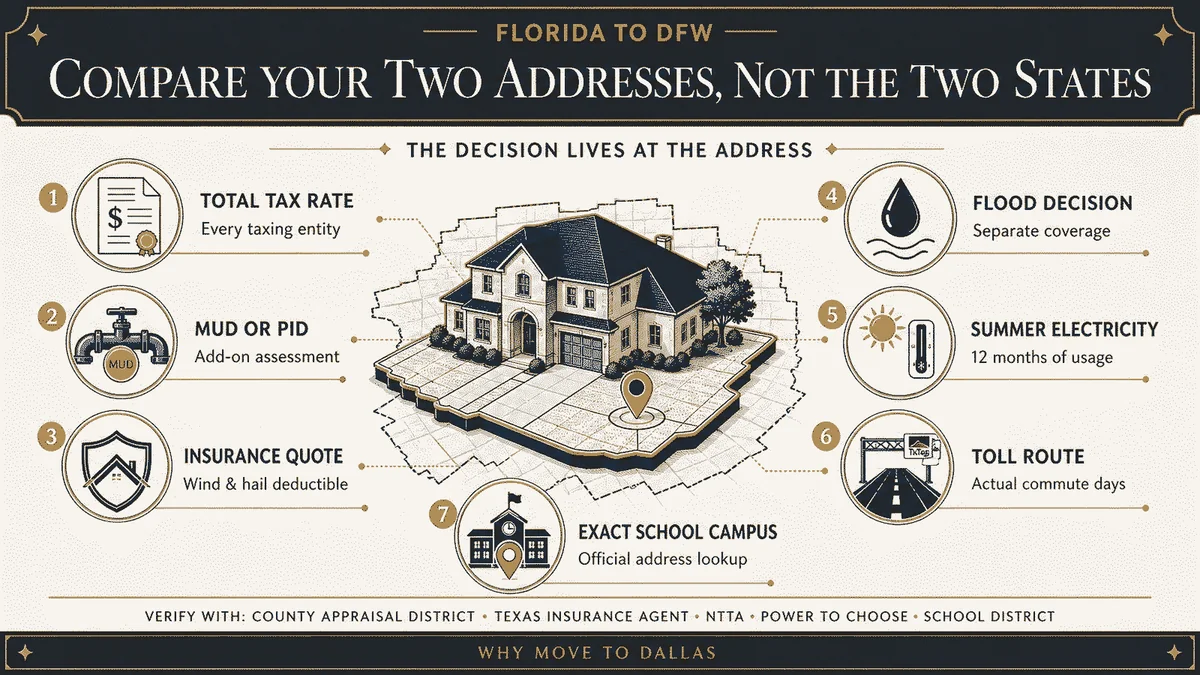
| Total tax rate | Every parcel sits inside a different combination of city, county, school district, college, and hospital district rates | Pull the parcel record from the county appraisal district and add every listed entity |
| MUD or PID assessment | Many newer North DFW communities carry a municipal utility district or public improvement district charge on top of the ordinary rates | Search the property's district obligations in the Texas Comptroller special purpose district database and read the seller's disclosure |
| Tolls | Several North DFW commutes are much faster on tolled roads, and the cost scales with in-office days | Price your actual route on the NTTA toll rate map and multiply by commuting days |
| Summer electricity | Most of DFW is in the deregulated retail market, so the plan you choose changes the bill on the same house | Compare plans on the Public Utility Commission's Power to Choose site and ask the seller or builder for 12 months of actual usage |
None of these are exotic. They are ordinary line items that a Florida family has no reason to expect, and together they are usually the difference between a comparison that holds up and one that falls apart after closing.
Model Your Own Numbers Before You Set a Budget
Use the Dallas Cost Calculator to test the categories that actually move a DFW monthly payment: property tax, homeowners insurance, summer electricity, vehicles, and tolls.
Open the Cost Calculator →Compare Your Two Addresses, Not the Two States
Here is the process I walk families through. It takes about an afternoon and it replaces every state average you have read.
- Price and financing. Set the target purchase price, down payment, and a current rate quote from a lender licensed in Texas. Ask the lender to escrow taxes at the reassessed value, not the seller's bill.
- The complete tax rate. Add every taxing entity on the parcel record, then check for a MUD or PID obligation. Do this for each candidate suburb, because the spread across DFW is meaningful.
- Homestead eligibility and timing. Confirm with the county appraisal district when you can apply and which tax year the 10 percent cap first protects.
- A real insurance quote. Include the wind and hail deductible, the roof settlement terms, the replacement cost limit, and a decision on separate flood coverage.
- Electricity and tolls. Use the actual home's usage history and the actual work and school routes, at the hours you will really drive them.
- The exact campus. Verify school assignment through the district's official address lookup for the specific property, then confirm it with the district before you make an offer.
Run that stack for your current Florida home and for two or three DFW candidates. Whatever the answer turns out to be, it will be yours rather than a statewide average that describes no one.
Work Location Is the First Filter
DFW has no single downtown that anchors everyone. Major job centers are spread across Downtown Dallas, Las Colinas and the airport corridor in Irving, the Legacy area in Plano, Richardson, Frisco, and Downtown Fort Worth. The Dallas Regional Chamber counts dozens of Fortune 1000 headquarters across the region, including American Airlines in Fort Worth, Charles Schwab in Westlake, McKesson in Irving, and AT&T, Southwest Airlines, and Texas Instruments in Dallas.
That density is an advantage when you are job hunting and a trap when you are house hunting, because a community that is comfortable for an office in Plano can be punishing for a daily trip to Fort Worth. Map the actual office, the expected arrival time, and the number of in-office days before you look at a single listing. If both adults work, map both. If you are remote, say so out loud and give yourself permission to choose on schools and community instead.
Our guide to where to live in DFW based on where you work breaks the region down corridor by corridor.
A Starting Shortlist of DFW Communities
These are common starting points for out-of-state searches, chosen here for objective reasons: current home price band, housing pattern, work corridor, and school data that still must be verified at the address level. They are not equivalents to Florida communities and they are not a ranking. A remote household can give more weight to home type or daily amenities. A hybrid or on-site household should map the exact office, arrival time, in-office days, toll route, and airport needs before expanding the radius.
| Community | Current median | Niche grade | TEA 2026 district rating | Home and work-pattern filter | Homes |
|---|---|---|---|---|---|
| Plano | $528K | A | Plano ISD: B (85) | Established housing; test Legacy, Richardson, downtown Dallas, and hybrid schedules separately; split district zoning is common | View homes |
| McKinney | $502K | A | McKinney ISD: B (87) | Historic core plus newer communities; map Plano, Legacy, Frisco, and Richardson for the actual office schedule | View homes |
| Allen | $513K | A+ | Allen ISD: A (90) | Established housing; test Plano, Richardson, and Legacy access, including any toll route used on office days | View homes |
| Frisco | $673K | A+ | Frisco ISD: A (91) | Newer and established planned communities; map the exact office and verify split district zoning by address | View homes |
| Prosper | $842K | A | Prosper ISD: A (91) | Newer homes and a higher current price band; add HOA, MUD or PID, and the full in-office route before comparing | View homes |
Niche grades are separate private ratings from current profiles for Plano ISD, McKinney ISD, Allen ISD, Frisco ISD, and Prosper ISD, accessed October 4, 2026 through the site's live profile dataset. Official TEA results come from the 2026 A-F release and the statewide ratings spreadsheet. Neither district rating is a promise about an individual campus.
Newer and more affordable options a little further out include Celina, Little Elm, and parts of Lewisville. If DFW Airport or Las Colinas is your work node, add Flower Mound to the route test. Whichever direction you go, compare the full set on the DFW suburbs hub and read our guide to the best DFW suburbs for families and our Dallas cost of living breakdown alongside it.
Fair housing rules also shape how I can help. My job is to give you objective resources and help you evaluate homes against criteria you define, not to steer you toward or away from communities. If you have questions about crime or safety, the right sources are the local police department's crime map, NeighborhoodScout, and City-Data, and you should review them yourself.
In my own experience with families arriving from Florida, the adjustment that catches people off guard is rarely the house. It is realizing that the commute, the school address, the toll route, and the insurance quote all belong to the same decision. I would rather help a family rule out an attractive house in week one than watch them discover in month three that the weekly routine does not work.
A Realistic Florida to DFW Sequence
About 90 days out
Confirm where work will anchor you and whether the role is in-office, hybrid, or remote. Talk to a lender licensed in Texas and build the full monthly number, not just principal and interest. Decide whether you need to sell in Florida first, and whether a short term rental in DFW would take pressure off the timing.
About 60 days out
Narrow to two or three suburbs using work location, price band, and district. Run the cost stack above on a sample address in each. Plan a scouting trip or a set of virtual tours, and see each area on a weekday at the hours you would actually be driving.
About 30 days out
Tour homes, verify campus assignment on your top choices, get insurance quotes on the specific properties, and make an offer. During the option period, have the inspector walk you through roof condition, drainage, foundation movement, and HVAC performance, all of which behave differently here than in coastal Florida construction.
Moving logistics
Interstate transit times vary by carrier, route, and season, so ask each mover for its written delivery window rather than assuming a number. The Federal Motor Carrier Safety Administration's Protect Your Move site explains how to verify a mover's registration and how valuation coverage works. Keep school and medical records with you, and plan for any stretch when the family may be down to one vehicle.
Frequently Asked Questions
Is Texas cheaper than Florida for families?
It depends on the two addresses. Neither state charges an individual income tax, and both carry significant insurance exposure. A Florida homestead may have years of Save Our Homes protection, while a Texas buyer needs a new parcel-level estimate without the seller's exemptions or cap. Compare actual current costs with a specific DFW property.
Do both Florida and Texas have no state income tax?
Neither state imposes an individual state income tax, so that line is generally a wash in a Florida to Texas move. The consequential differences are parcel-level property tax, exemptions, and address-specific homeowners insurance. Compare both homes and ask a tax professional about your circumstances rather than applying a statewide conclusion.
Will my homeowners insurance go down when I move to Dallas?
Do not assume it will. The Texas Department of Insurance reports a preliminary statewide average annual homeowners premium of $3,489 for 2025, and Dallas Fed research places DFW among Texas metros with the highest insurance burden. The statewide figure is not a quote. Compare your Florida declarations page with an address-specific Texas quote.
Does Texas homeowners insurance cover flooding?
Generally no. FEMA states that homeowners and renters insurance does not typically cover flood damage, and that more than 20 percent of flood claims come from properties outside high risk flood areas. Inland DFW is not hurricane exposed, but flood coverage is still a separate decision. Check the flood map for the specific property.
What is a MUD or PID, and why does it matter in DFW?
A municipal utility district or public improvement district is a local entity that adds an assessment on top of ordinary property taxes, often in newer master planned communities across North DFW. It can add a meaningful amount to a monthly payment. Check the property's district obligations and the seller's disclosure before you make an offer.
Which DFW communities should I compare when moving from Florida?
Start with your actual worksite, office days, budget, and home type. Plano, McKinney, Allen, Frisco, and Prosper create different housing and commute tradeoffs. Remote households can weight home type and daily amenities more heavily. Every household should verify total parcel costs and exact school zoning before choosing a home.
Why does my Florida county and coastal or inland location matter?
Your starting county and coastal exposure shape the insurance, wind, flood, property-tax, commute, and home-type assumptions you bring to the move. A Miami or Broward comparison can start differently from Tampa, Orlando, Jacksonville, or inland north Florida. Carry your own declarations page, parcel bill, and home details into the DFW comparison.
Data note: Local home prices and school grades use the site's suburb profile dataset and update independently of this article. Market figures are not an appraisal or a prediction. Tax and insurance information here is general education, not tax, legal, or insurance advice. Confirm your situation with the county appraisal district, a licensed insurance agent, and the appropriate tax or legal professional.
The Bottom Line
A Florida to Dallas-Fort Worth move is worth running the numbers on. Just run the right numbers. The state comparison is mostly noise once you know that neither state taxes income and both charge a lot for insurance. The decision lives at the address: the complete tax rate, the MUD or PID obligation, the insurance quote and its wind and hail deductible, the flood decision, the electricity plan, the toll route, and the verified school campus. Get those seven things for two or three specific homes and the answer will be obvious.
Ready to find the right suburb for your family? Contact Kristen at whymovetodallas.com.

Free Relocation Guide
The DFW Family Relocation Guide
Schools, suburbs, property taxes, and the buying process, organized for families planning a move to Dallas-Fort Worth.
Get the Free Guide →Kristen Carpentier, TREC License #760457 · eXp Realty, 15950 Dallas Pkwy #400, Dallas, TX 75248 · Licensed in Texas only · Consumer Protection Notice · Information About Brokerage Services · Equal Housing Opportunity