


You find a house with the kitchen, yard and space you have been looking for. Then you notice the HOA. If you are moving to Texas, it is worth slowing down long enough to find out what that membership would mean for your everyday life. The boat you want beside the garage, the fence you plan to replace and the pool you would use all summer belong in the decision.

Watch HOA or No HOA in Texas? What You Give Up and What You Get for the three questions I would ask about a specific association. This written guide gives you the document checklist to keep beside you.
Quick answer: Buying a house with an HOA in Texas can make sense when the property's written rules fit how you live, the services are worth the dues to you, and the current fees and possible changes fit your budget.
This guide addresses residential subdivision HOAs, not condominium associations, which can fall under different laws and forms. It is educational information, not legal, tax or investment advice. Have a Texas real estate attorney advise you on your documents or a disputed rule.
HOA or no HOA: which trade works for you?
An HOA can enforce restrictions and maintain shared property, with the details set by the association's governing documents and applicable law. The Texas State Law Library's HOA explanation is a useful starting point. Membership tells you there is an association; it does not tell you whether its rules or services suit your household.
An HOA may fit when...
You want written exterior-maintenance standards and someone responsible for the shared spaces. You would use the amenities, accept the approval process for changes, and can budget for the assessments.
A home without an HOA may fit when...
You want fewer association-level restrictions on vehicles, outdoor projects or exterior choices. You are comfortable arranging your own services and checking which deed restrictions and local rules still apply.
I would begin with the things you are least willing to change. If keeping your work truck at home matters more than having a community pool, say that before building a shortlist. If you would happily trade exterior-design flexibility for maintained shared spaces, that matters too. Neither preference makes one neighborhood better for everyone.
A listing that says “no HOA” still needs a document check. Ask your agent and title company about any recorded deed restrictions affecting that parcel, and use the local ordinances guide to find the relevant city code.
Ask for the documents that answer different questions
For properties covered by Texas Property Code Section 207.003, a qualifying written request starts the subdivision-information process. The statute provides for current restrictions, bylaws and rules, and a resale certificate. Requester verification, payment and the applicable law matter, so confirm who orders the package and what is needed to complete that request.
- Restrictions: Find the provisions governing use of the lot, parking, exterior changes, fences, outbuildings and leasing where applicable.
- Bylaws and rules: Learn how the association operates and what additional procedures or policies apply. Ask for current architectural guidelines and approval procedures if you plan changes.
- Resale certificate and attachments: Review the property's assessments and disclosed issues alongside the financial and insurance documents. The certificate is not a replacement for the restrictions.
Check that the package applies to the exact address, is current, and includes the attachments it lists. A sales brochure or the dues field in a listing cannot answer all of those questions. Keep your written request and the delivery dates with your contract records.
Which HOA rules would change the way you live?
Take your actual plans to the documents. Can the boat or trailer stay where you intend to park it? Does a work vehicle fall under a restriction? Does a shed need approval, and are there height, material or placement requirements? If you want to replace a fence or change the exterior, find the approval process before treating the project as part of the purchase.
Two associations can answer the same question differently. Ask for the relevant provision rather than relying on “people do that here.” If the wording is unclear, get clarification in writing and legal advice where needed. An existing neighbor's fence or vehicle is not proof that your proposed use is permitted.
Also ask how restrictions and rules can be changed and whether changes are being discussed. Buying under the current documents does not mean every rule stays the same forever.
Section 207.003 requires disclosure of conditions the board actually knows violate the restrictions or rules. Unless a dedicatory instrument requires it, the association does not have to inspect before issuing the certificate. A clean certificate does not guarantee that an unapproved fence, addition or other issue is absent.
If a violation is disclosed, understand what remains outstanding and how it will be resolved before closing. Ask for documentation of any claimed resolution. Do not assume the disclosure itself makes the problem go away.
Texas law also places limits on enforcement. For associations and actions covered by Section 209.006, notice, a hearing opportunity and, for qualifying curable violations, a reasonable chance to fix the problem are important protections. Conditions and exceptions apply, including certain repeat violations. An actual notice deserves prompt attention, not an assumption that every fine can be erased later.
What do you actually get for the dues?
Some associations maintain a pool, trails, playgrounds or other shared facilities. Others maintain much less. Walk the spaces you expect to use, then ask who owns them, who operates them, what your membership includes and whether separate charges or access limits apply.

A pool you would use every weekend has a different value to you from one you would never visit. But even if you do not use an amenity, your assessment may still support common-area insurance, landscaping, administration and future repairs. Check what this association actually pays for rather than assuming the entire bill is an amenity subscription.
The TREC Form 37-5 is a voluntary official resale certificate template. It labels the current operating budget, current balance sheet and common-area property and liability insurance certificate as required attachments. Chapter 207 governs the statutory information for covered subdivision associations; the association need not use this exact form. Read the financial and insurance documents alongside the dues figure. Ask about major maintenance needs, reserves, approved projects and anything proposed that could change costs. Review disclosed unsatisfied judgments and pending suits, and ask your agent, lender, insurer or attorney what they mean for your transaction.
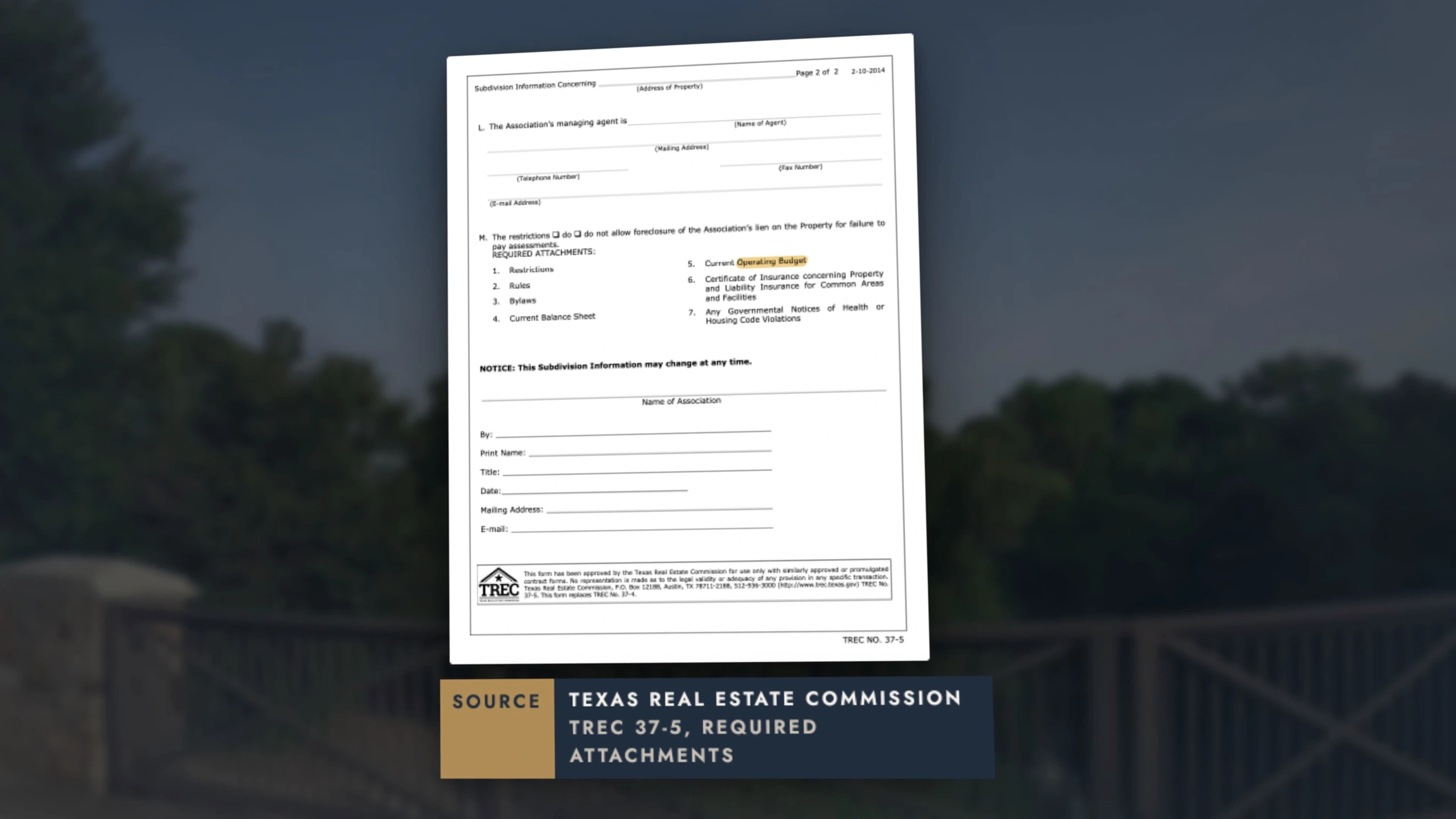
A balance sheet is a starting point for questions, not proof that reserves are sufficient. If a major shared facility needs work, ask how that work will be funded. If the association is responsible for a repair affecting the home you are buying, address that specifically. The TREC HOA addendum's repair notice warns buyers to be satisfied that the association will make desired repairs before signing.
Tell me about the vehicle, project, shared space or maintenance responsibility that matters to you, along with your budget and timeline, so we can make those questions part of the search.
Tell me what your home needs to allow →Compare regular dues, extra assessments and closing charges
Start with the amount and frequency of the regular assessment. A quarterly amount should not be compared directly with an annual amount. Annualize each, then divide by 12 for your household budget while remembering that the actual payments may come in larger installments.
| Cost | Where to look | What to establish |
|---|---|---|
| Regular assessments | Current resale certificate, budget, governing and payment documents, and service documents | Amount, billing frequency, due dates and which services are covered. |
| Special assessments | Certificate, approved assessment information and association follow-up | Any approved amount due after the certificate, its purpose, payment dates, and how your contract allocates it. |
| Transfer and document charges | Itemized association fees, your contract/addendum and closing figures | Each charge, the recipient, who pays, and whether it is already included elsewhere. |
Source: Section 207.003 and the voluntary official TREC Form 37-5. Review payment and service documents for due dates and coverage. This is a document checklist, not a quote or a typical Texas fee estimate.
The certificate reports approved special assessments within its scope; it cannot predict every future increase. Ask separately about proposals and upcoming work. The TREC form expressly warns that subdivision information may change. A low current assessment is not a promise that it will remain low.
Association transfer charges are also separate from title and lender costs. Have the association's itemized figures reconciled with the contract and closing statement so the same fee is not missed or counted twice. For the broader records to gather before buying remotely, use my five-record checklist for buying a house in Dallas from out of state.
Keep HOA assessments separate from property taxes and any applicable MUD taxes or PID assessments. Verify those through the parcel's taxing entities and assessment records, not the HOA certificate. My Texas property-tax guide for out-of-state buyers explains that separate part of the budget. Home insurance, utilities and any outside storage you would need also belong in your personal comparison.
Read the HOA documents before your contract deadlines
Ordering the package and having time to act on it are different problems. Before signing, know who will request it, who pays for it, when it is due and how the contract treats delivery. Do not wait until the closing appointment to learn that a restriction conflicts with something you need.
The option period in the standard TREC resale contract, Form 20-19, is negotiated, and the unrestricted termination right depends on the contract's terms, including timely payment of the option fee. Do not assume there is an option period or that it is still open just because you are waiting for documents.
The HOA addendum can provide a separate, short document-related termination right. In Form 36-11, paragraph A, the three-day language depends on the selected box and its completed terms, and the right ends before closing if that comes first. Under box 2, receipt can be deemed to occur on the specified date or actual receipt, whichever is earlier. Boxes 3 and 4 do not provide that paragraph-A three-day right. Builder contracts can work differently.
- Before signing: Read the selected addendum box and filled-in dates with your agent. Establish who orders the documents.
- When documents arrive: Save the receipt date, check for missing items and review your deal-breakers immediately. Do not presume that missing paperwork extends a deadline.
- Before any deadline: If something changes your decision, ask your agent and, where needed, your attorney about the actual notice requirements and time left.
Questions buyers ask about Texas HOAs
Can I choose not to join an HOA after buying?
When the property is subject to mandatory association membership, you should not budget or make plans on the assumption that you can opt out. Confirm whether membership is mandatory for that parcel and review the recorded documents before committing. Voluntary associations and condominium arrangements need their own review.
Can an HOA stop me from keeping a boat or work truck at home?
The answer depends on the applicable restrictions, rules and law. Check the exact vehicle, parking location and intended use against the documents. If that use is essential, resolve uncertainty before your contract deadlines rather than relying on what a neighboring owner appears to do.
What happens if HOA assessments go unpaid?
Take them seriously as a housing obligation. The resale certificate addresses whether the restrictions allow foreclosure of an association lien for unpaid assessments. Applicable law and the documents govern the process. If you receive a collection notice, seek legal advice promptly instead of treating it as an ordinary exterior-rule warning.
Can a Texas HOA prohibit a child's lemonade stand?
Section 202.020 protects specified occasional sales of lemonade or other nonalcoholic beverages from a stand in the subdivision by someone under 18 with a property owner's permission. It bars the association from prohibiting or regulating those sales through restrictive covenants, including permit or fee requirements. Other applicable laws still need consideration.
Choose the rules you can live with
The most useful question is whether this association fits the way you will use this home. Read the restriction that affects your boat or project. Walk the shared spaces. Put recurring and one-time costs on paper. Confirm the deadlines before assuming you have another few days to decide.
If you are ready to compare homes, share your priorities and timeline so those checks can shape the shortlist.
Use the cost calculator to compare what a budget buys by suburb alongside property tax, home insurance and summer electricity, then add the property's verified HOA and any special-district costs.
Open the Cost Calculator →
Also exploring DFW?
Browse all suburb guides →Free planning guide
The DFW Family Relocation Guide
Keep the HOA decision alongside your housing budget, school research and moving timeline.
Get the Free Guide →Kristen Carpentier, TREC License #760457 · eXp Realty · 15950 Dallas Pkwy #400, Dallas, TX 75248 · Licensed in Texas only · Consumer Protection Notice · Information About Brokerage Services · Equal Housing Opportunity