


Let me say this upfront: I love living here. My family moved to DFW from Phoenix, we raised four kids here, and I now spend my days helping families relocate to the Dallas suburbs. But Texas is not for everybody, and Dallas is not for everybody. I would rather you hear the honest list now than discover it the July after you close. So here are the ten things that make some families think twice, told the way I tell my own clients.
Quick answer: The most common reasons families decide against moving to Dallas are high property taxes (roughly 2% to 2.5% combined), toll and commute costs, summer heat, allergies, and the sheer size of the metro, which makes choosing the wrong area for your job or schools an expensive mistake.
Watch: my full breakdown of the ten reasons, with the stories that did not fit in writing.
1. Church Is a Big Part of Life Here
You have moved to the South, and Sunday church is woven into community life in a way that surprises families from the West Coast or the Northeast. There are big churches and little churches, and genuinely one for everybody. Youth sports leagues schedule around Sunday mornings. Community events often start at noon. Wednesday night youth groups are common enough that some schools quietly avoid scheduling games against them.
When we first moved here, our daughter came home from middle school and told us her friends invited her to "pray to the flagpole." We laughed, corrected the preposition, and learned that kids from all different backgrounds really did meet at the flagpole once a week for a quick devotional before class. She went, made friends, and we still joke about it today. If faith is part of your family's life, you will find your people fast. If it is not, nobody will pressure you, but you should know it shapes the rhythm of the week here.
2. The Construction Never Ends
DFW is one of the fastest-growing metros in the country, and the roads show it. When we moved here, I-635 was a years-long double-decker project. Today the attention is on US-380 through the northern suburbs and a rotating cast of widening projects everywhere else. I used to drive to volleyball tournaments at 5 AM on Saturdays and sit in what felt like Friday rush hour because of lane closures.
The practical advice: before you fall in love with a neighborhood, check the state and county project maps for the corridors you would drive daily. A 25-minute commute on today's roads can be a 50-minute commute for the two years a widening project runs, and weekend full closures are a real thing here.
3. Toll Roads Add Up Fast
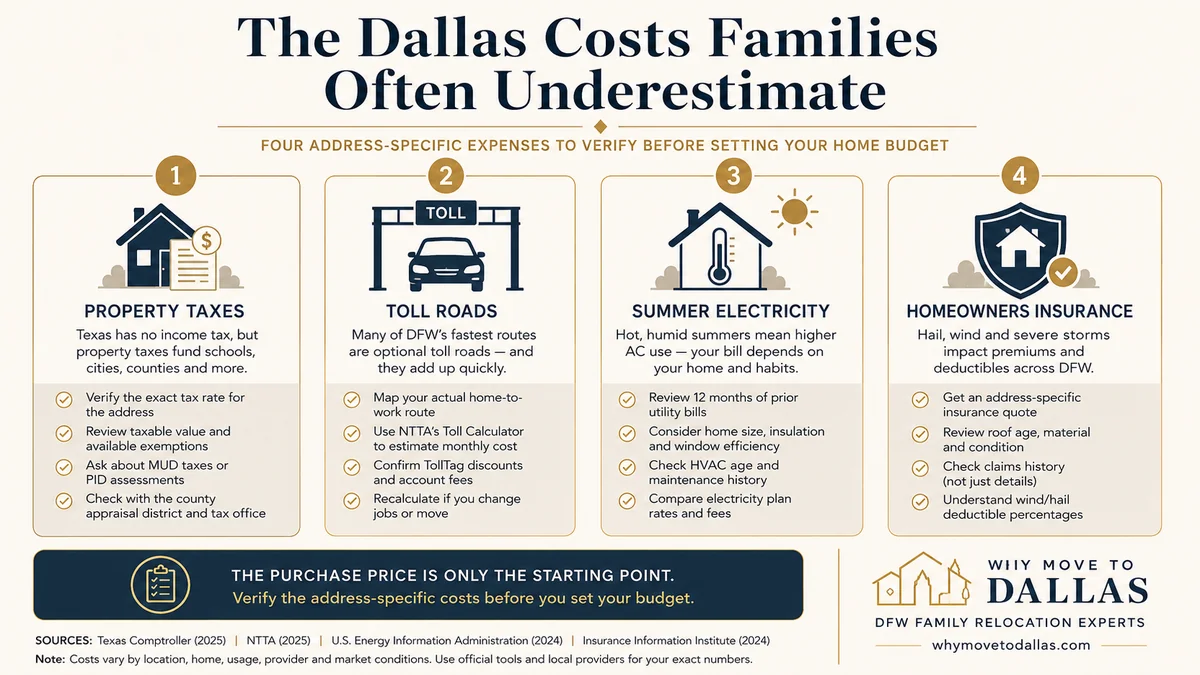
Dallas runs on toll roads: the Dallas North Tollway, the President George Bush Turnpike, the Sam Rayburn Tollway (SH 121), and more. If your commute uses one or two of them daily, budget roughly $80 to $160 a month, and run your own route through the NTTA toll calculator before you commit to a commute. We have friends who asked us, with a straight face, whether $300 a month in tolls was normal. For their particular commute, it was.
Two things newcomers never expect: even driving into DFW Airport to drop someone off triggers a terminal access charge based on time inside the airport roadway system, and the toll bill arrives per segment, so a single "cheap" toll road crossing can ring up several charges in one trip. Dallas Love Field, closer to the city center, has no entry toll. Where you live relative to where you work decides whether tolls are a rounding error or a car payment.
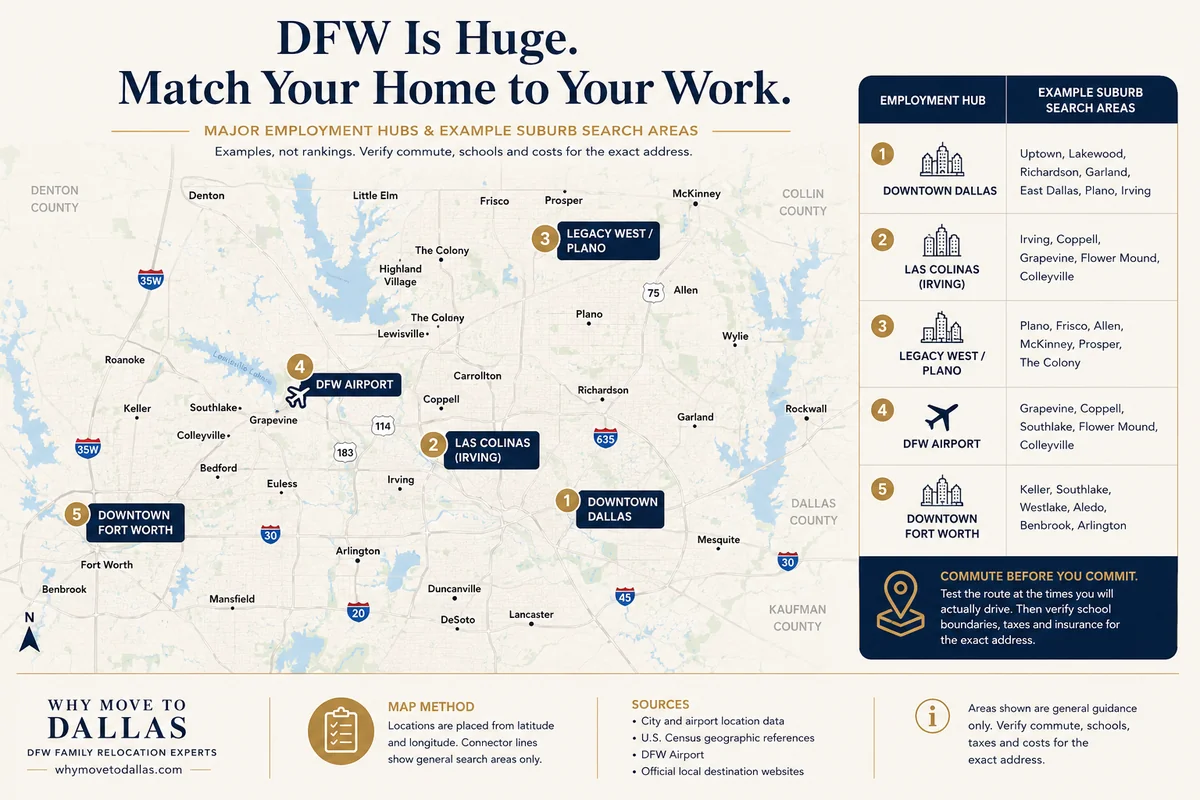
4. DFW Is Huge, and the Wrong Area Costs You
We moved from Phoenix and thought we understood big. We did not. The DFW metroplex is home to more than 8 million people spread across roughly 9,000 square miles, and it is still growing in every direction because there are no mountains or coastlines to stop it.
Here is why that matters: DFW is not one housing market or one commute. Living in Frisco and working in Fort Worth is a fundamentally different life than living in Frisco and working at Legacy West. Families who pick the suburb first and think about the job corridor second are the ones who call me a year later wanting to move again. Match the suburb to the commute and the schools first. My guide to all the DFW suburbs exists for exactly this reason, and if you are still weighing Dallas against another Texas metro entirely, start with my Dallas vs Austin comparison.
5. The Weather Swings Hard: Heat, Hail, and Winter Ice
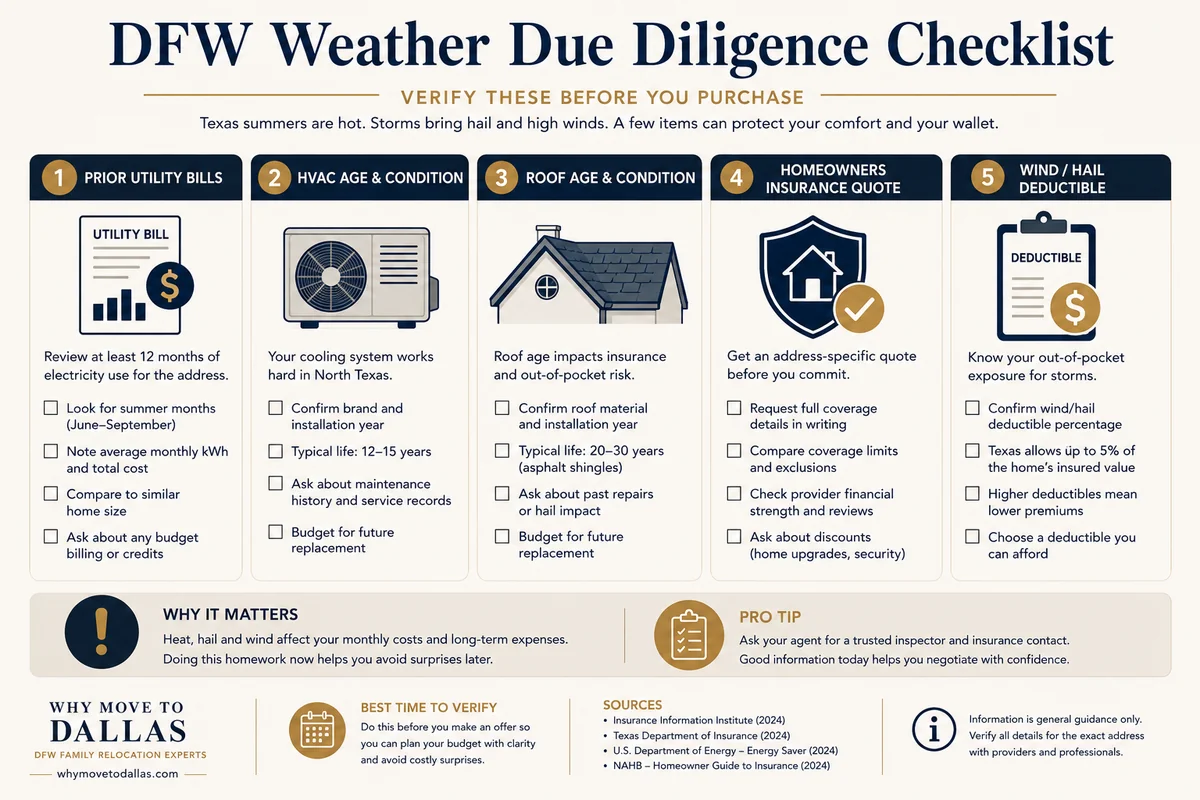
Summers are hot and humid, with long stretches over 100 degrees, and your air conditioner will run nearly nonstop from June through September. Budget $250 to $400 a month for summer electricity in a typical family home, then enjoy the mild winter that follows.
The bigger surprise is the ice. Every year or two, a winter storm drops freezing rain on a metro that does not own enough plows or sand trucks to deal with it, and the safest move is simply to stay home for a day or two until it melts. Tornado sirens get tested monthly, and while touchdowns inside the suburbs are rare, hail is not: North Texas sits in what insurers call Hail Alley, and it shows up in your homeowner's premium. It is all manageable, but it is real, and it is different from the postcard version of Texas weather.
6. Allergies Hit Different in North Texas
Our mild winters mean nothing fully dies off, and Dallas regularly lands on the national worst-cities-for-allergies lists. Ragweed in the fall, cedar in the winter, grass in the spring. When we first moved here my allergies flared for weeks and I could not figure out what hit me, and the same story repeats for almost every transplant we know. If someone in your family has serious seasonal allergies, talk to your doctor about a plan before the first spring, not after it.
7. The Bugs Are Not Shy
I tell people I married my husband because he handles the bugs, and I am only half joking. Warm climate plus lake country means mosquitoes that will find you the moment the grass is wet, June bugs that dive-bomb the porch lights every summer, and cicadas loud enough some evenings that you cannot hear yourself think. Cities spray, backyard systems help, and you adjust. But if bugs are a dealbreaker, I am legally obligated as your honest guide to tell you: Texas has bugs.
8. Property Taxes Are High
This is the big one, and the reason I never let a family shop at the top of their budget without running the tax math first. Texas has no state income tax, and property taxes are how the bill gets paid. Combined rates across DFW typically run 2% to 2.5% of assessed value depending on the city, county, and school district, and some new-construction areas add municipal utility district (MUD) taxes, public improvement district (PID) assessments, or both on top.
The honest math on a $500,000 primary residence: the homestead exemption removes $140,000 from the school district portion of your taxable value (per TX Tax Code §11.13(b)), which softens the blow, but in many suburbs the annual bill can still approach or exceed $10,000 depending on the property and exemptions. For most households above $100,000 in income moving from California, New York, or Illinois, the income tax you stop paying more than covers it, but run your own comparison rather than assuming. For families moving from lower-tax states, it can be a genuine shock. Run your own numbers before you set your budget, not after: my cost of living in Dallas breakdown walks through the full picture.
9. You Will Be Busier Than You Planned
This one sounds like a humblebrag, but ask any family who moved here. Between school activities, youth sports, church groups, community events, and a metro with professional teams in every sport, your calendar fills itself. When our kids were in school we were at something nearly every night of the week. For a lot of families that is exactly the life they wanted. But if you are picturing quiet weekends, you will have to defend them on purpose, because Dallas will happily book every one of them for you.
10. Trucks, Guns, and Sweet Tea
Texas culture is real and unapologetic. Hunting is a normal weekend hobby, gun ownership is common and openly discussed, trucks outnumber sedans in most school pickup lines, and sweet tea is offered everywhere from barbecue joints to booster club tables. Our daughter refused to touch the stuff all through high school while every one of her friends drank it by the gallon.
None of this is required. Plenty of transplants keep their own habits and are welcomed anyway, and the northern suburbs in particular are full of families from California, Chicago, and the East Coast. But if the culture itself would grate on you daily, that is worth being honest with yourself about before you move, not after.
So Should You Still Move to Dallas?
Here is my honest read after years of raising a family here and helping others do the same: most of these ten reasons are trade-offs, not dealbreakers. You trade property taxes for no income tax. You trade summer heat for mild winters. You trade toll costs for access to one of the strongest job markets in the country. The families who regret moving here are almost never surprised by Texas itself. They are surprised by picking the wrong part of a 9,000-square-mile metro for their specific job, schools, and budget.
- Your career or your spouse's employer is here, and you pick a suburb that matches the commute
- Top-rated school districts are a priority and you want many options at many price points
- You are coming from a high-tax state and the no-income-tax math works clearly in your favor
- A busy, family-forward community calendar sounds like a feature, not a bug
- You can live with hot summers in exchange for mild winters
If you read all ten and thought "we can handle that," the next step is not picking a house, it is picking the right part of the metro. That is the decision that makes or breaks the move. If you are also weighing the western half of the metroplex, my honest take on what to know before moving to Fort Worth covers that side.
Frequently Asked Questions
What is the biggest downside of living in Dallas, Texas?
For most relocating families, it is the combined cost of property taxes (roughly 2% to 2.5% of home value) plus tolls and summer utilities. Texas has no state income tax, which offsets this for most households moving from high-tax states, but the monthly bills surprise families who did not run the math first.
Are toll roads in Dallas really that expensive?
They can be. Regular commuters on the Dallas North Tollway, PGBT, or SH 121 typically budget $80 to $160 a month, and heavy cross-metro commutes can run higher. Where you live relative to your job decides the bill, which is why commute mapping should come before house shopping.
How hot does it actually get in Dallas?
Summers regularly run 95 to 105 degrees from June through September with real humidity, and family homes commonly see $250 to $400 monthly electric bills in peak summer. In exchange, winters are mild, with only the occasional ice storm that shuts things down for a day or two.
Is Dallas a good place to raise a family despite these downsides?
Yes, for the right family. DFW offers dozens of A-rated school districts, deep youth sports and activity infrastructure, and strong job markets. The families who struggle usually picked a suburb that did not match their commute or budget, not the metro itself. The area you choose matters more than the city.
What are the hidden costs of living in Dallas?
The four that surprise newcomers most: property taxes of roughly 2% to 2.5% combined, MUD or PID assessments in some new-construction areas, toll costs for many commutes, and summer electricity spikes. All four vary by exact address, so verify each one before setting your budget.
Which Dallas suburb should my family choose?
It depends on your four levers: schools, commute corridor, budget, and lifestyle. A family working at Legacy West has different right answers than one commuting to DFW Airport. Start with the suburb guides at whymovetodallas.com or use the Suburb Matcher for a personalized shortlist by email.
Dallas gave our family a life we could not have built where we came from, and it has done the same for hundreds of families I have helped since. It just rewards the people who go in with clear eyes. If you want help matching the right suburb to your job, your kids, and your budget, that is what I do every day.
Ready to find the right suburb for your family? Contact Kristen at whymovetodallas.com.

Free Download
The DFW Family Relocation Guide
Schools, suburbs, property taxes, and the buying process, everything your family needs to make the right move.
Get the Free Guide →Kristen Carpentier, TREC License #760457 · eXp Realty, 15950 Dallas Pkwy #400, Dallas, TX 75248 · Licensed in Texas only · Consumer Protection Notice · Information About Brokerage Services